
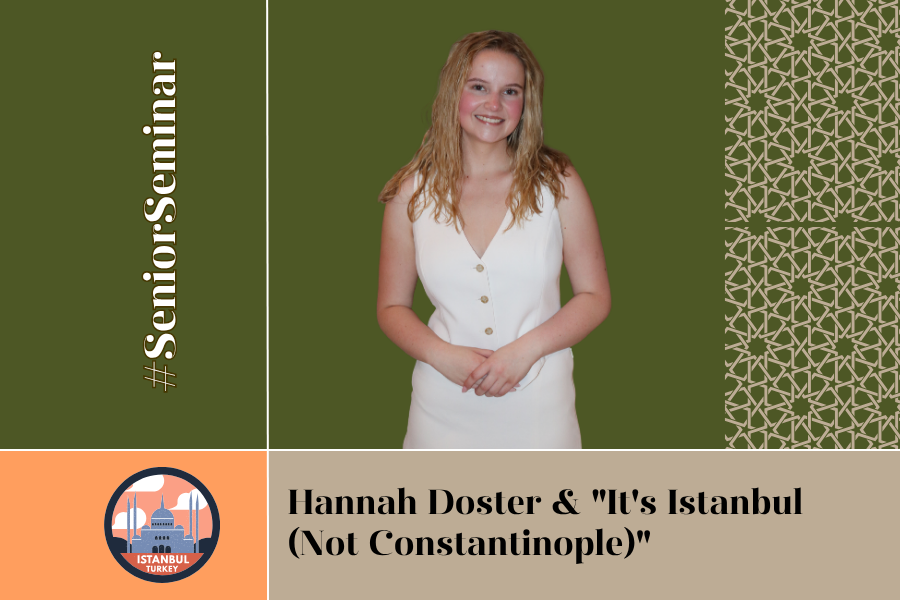
#SeniorSeminar Interview: Hannah Doster & "It's Istanbul (Not Constantinople)"
I got interested in history through watching Mysteries at the Museum with my dad. The presenter, Don Wildman, went to different museums and talked about unusual objects, and what role they played in history. The series ran for 22 seasons. There was one episode I really liked, in which Wildman focused on the brass knuckleduster used by Kate Warne (1833-1868), a detective for the Pinkerton Detective Agency, who uncovered the 1861 Baltimore Plot to assassinate president-elect Abraham Lincoln. The episode showed how the object connected to, influenced, history. I feel that history is oftentimes stranger than fiction; in my mind history is like a very trashy reality TV show.
I came to FSU as an exploratory major. I knew I wanted to major in the humanities, in the arts, as that is where my skill set naturally lies. I felt that FSU had a very strong program in the liberal arts. I am graduating this spring, and I am sad that I cannot take any more history classes because of that.
What made you choose this senior seminar?
The title of Dr. Doel’s class on historical landscapes intrigued me. I had never thought of looking at history through landscape. In hindsight, I realize that, of course, landscape impacts history. But when I did historical research in the past, I did not really pay attention to how the natural environment influenced the course of history. Having a senior seminar that was focusing on that angle alone was a huge revelation.
What topic did you work on for the senior seminar?
I started up with one topic but then changed it halfway through the semester. My original plan had been to work on Pompeii and Herculaneum and how the tourism industry changed their environments. I did some preliminary research, but then I realized that I was not truly passionate about this. I pivoted to examining the siege of Constantinople in 1453 instead. I had been fascinated by that event for years. I knew the story, and in my head, I had already related all the assignments we had done in the senior seminar so far to the siege, thinking about the Theodosian walls, the location of the city and so on. Dr. Doel approved my change of topic.
I got into the siege of Constantinople through the Netflix series Rise of Empires: Ottoman. I watched that with my dad too. I liked the format, it was done on a bigger budget, they mixed reenactments with interviews with historians. The narrative was very immersive; the history told felt like a lived experience. It humanized the historical figures and made them very relatable. At least for me. My specific senior seminar topic was to show how medieval warfare, especially military strategy, was dictated in terms of landscape. I used the fall of Constantinople as a case study for my paper. The Ottomans organized their siege of the city in response to the challenges of the landscape.
What kind of sources did you use?
There were a lot of really good secondary sources that covered the timeline of events, and I also knew a lot about the siege already. My favorite primary sources were a diary by a Venetian merchant who was present throughout the entire siege. And I also discovered another personal account, this time by a Greek magistrate which he wrote while working for at the court of Sultan Mehmet II. While this second source was written after the event, it still presented a Greek perspective on the siege and fall of the city. Other material I used was various forms of apocalyptical literature, poetry, and so on, that people composed at the time of the siege. The fall of Constantinople really felt like the end of their world!
Most of the Ottoman sources I looked at were written after the event and helped me set the whole affair in context. I was concerned with mapping their siege decisions on the landscape. For example, Mehmet II, who was really still a young adult by the time he took command, was frustrated that his admiral kept getting defeated and was unable to get around the Great Chain that the Byzantines had stretched across the Bosporus. Mehmet II ordered a fleet of 70 warships to be dragged over land around the chain and managed to surprise the Byzantine defenders. Here the landscape he was operating in presented a challenge, and his policy was a direct response to this challenge.
What really surprised you about your research findings?
That’s a good question. Because I have been researching the siege of Constantinople for about eight years, I have gone down pretty much every rabbit hole there is. Throughout all that time, I have been astounded by Mehmet II’s character, his ingenuity in terms of strategy, and his ability to command the Ottoman court — especially when compared with his father. Constantinople had been besieged by 23 separate armies by that time, none of them successful. It had been predicted that Constantinople would be taken by an Ottoman sultan, who would then become the most celebrated sultan of all time. Mehmet II was set to be that sultan. He was 19 years old and determined to take the city.
How did you get started with your paper?
The hardest part for me is usually framing my thesis. For this paper, I started by setting down a general outline of the points that I wanted to make. Since I was using an event as a case study, I knew that I would use a narrative format to make the argument that in medieval warfare landscape dictated strategy. My thought initially had been to take the reader through the sequence of events of the siege and at each step ask: What would you do next? I wanted to make my reader think like an Ottoman strategist. I was able to do it for the presentation too, even with the time constraints we had. I used the ‘choose your own adventure’ format.
In terms of starting my research, it was a matter of collecting primary and secondary sources. Because I already knew the overall narrative, I knew what to look for and it was relatively easy to find material.
How did you stay on top of this project?
What I did, I would not recommend to others. Not unless you know your topic already. From the moment I switched to working on the siege of Constantinople, I knew what my essay was going to look like and what my presentation would look like. It was literally just a matter of sitting down and typing it out. Because of that, I waited until Thanksgiving break to actually write things down.
First, I wrote the presentation. I wrote an eight-page script, and then I used my presentation as my paper outline. I added in the sources and quotations, reformatted the language, and expanded on my points. I got to go down little rabbit holes in my paper for which I did not have time during the presentation.
What was the biggest challenge and how did you overcome it?
I think it was preparing the presentation. I was a little nervous about that. I wanted to make sure that the information I presented was easy to digest and had a clear narrative structure. I did not just want to regurgitate a bunch of data. But I also did not want to be so specialized that no one could follow me. I tried to take a more conversational tone, and also to draw parallels to daily life. Because when you can relate something to yourself, then you can understand it better.
What advice would you give History majors who are thinking about taking the senior seminar?
I would say: do the subject that interests you. Don't do something that you think will be easier because there might be more primary or secondary sources. Do something that you are passionate about, because when you are passionate about something, that passion and that excitement show through. That gets people excited to learn about what you're teaching them. I found out that my excitement about medieval warfare got the other people in my class excited about medieval warfare too.
If you could go back to the beginning of the semester, what would you tell yourself?
I would tell myself: do the Siege of Constantinople right away! But other than that, I think I'd want to tell myself, work a little bit more on the paper throughout the semester rather than waiting until Thanksgiving break. I was able to get it done, and it was fine, but being able to split things up over time might have made the semester easier. And lastly, I would tell myself to learn quickly about the filters on JSTOR and other databases to be able to narrow search results down.
What's coming next?
What's next? I am so excited to be attending law school at the College of William and Mary in Colonial Williamsburg, Virginia, in the fall. There are a few things I would love to do with a law degree. I would like to teach the history of law, because I think that history and law are so deeply intertwined. History tells the stories of the societies for whom the laws are made, and law shapes the societies in return. Laws are the product of everything that goes on at the time.
But I am also interested in constitutional law and trial advocacy as I am a pretty objective person and would like to do something to which my skill set is suited.