
What is it like to be a teacher? An interview with Ph.D. candidate Madeleine Stout
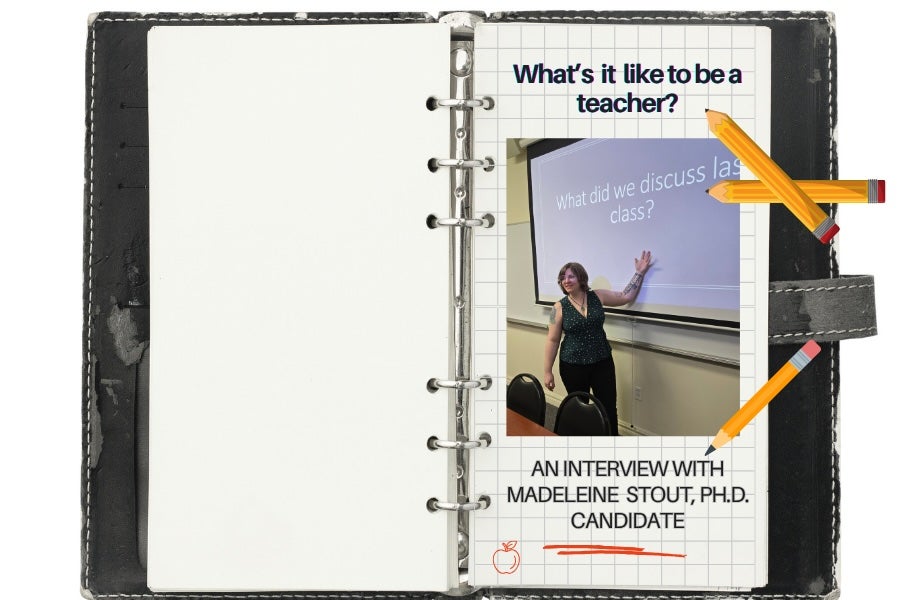
I grew up with a lot of dinner-time debates about history. My mother got her B.A. in History, and my father likes history too. As a child I found those discussions very boring. When I went to college, I told myself: I am not doing History. Then junior year rolled around, and as an international affairs major I had taken so many history classes that I was told I had enough credits to add history as a second major, I just needed to take the capstone course. On the last day of my junior year, I registered for the History major.
I went directly from undergrad to doing an M.A. in History. That was a hard leap, but it cemented that I liked to learn about history, even when it was difficult. The hardest part was understanding the theory aspect of history. The M.A. also made me realize that I did not want to go straight from the master’s program into the Ph.D. So, I took a year off and accepted a teaching position at a small university in Philadelphia. I taught two classes that year, one in fall, and one in spring – which ended up being the COVID semester when everything went online. I got to experience teaching online too. During that year, I fell in love with teaching, but I missed taking history classes.
I applied to FSU to become a Russian historian which had been my dream since undergrad. During my Ph.D. coursework, I realized that my path steered more towards modern U.S. history. I took classes in African American history, Cold War history, Russian history. My dissertation research focuses on the experiences of African American women who traveled to the Soviet Union in the 1930s. In a way, I am trying to expand the Cold War period to before 1947.
Before teaching at FSU, I had taught early World History, early U.S. history, and early African American history. I taught one as a once-a-week evening class, one at 8am three times a week, and one twice-a-week in the afternoon. Each had its own challenges in terms of classroom interactions and assignments. Those classes taught me a lot. Since I am a modern U.S. historian, I was very excited to finally get to teach AMH 2020.
How does it feel to teach?
Oh, it can be fun, scary, stressful, rewarding, challenging and exhilarating, all at the same time. The first time you teach a class, you often have to develop the lectures week by week. That is stressful. But I love the action of teaching, that is exhilarating. I am a very animated lecturer which helps me engage with the students, and I get a good amount of interaction in the classroom. I want students to take away something new from every class. Teaching has made me rethink what common knowledge is, as what is common knowledge to me is in no way common knowledge to the students. A big part of my teaching philosophy is that students learn from us, but we learn from the students as well.
What is your goal as a teacher?
My goal is to inspire. I want to inspire students to think differently about history from what they might have experienced in high school. Sometimes I will tell my students about the historical debates surrounding a topic, so that they understand that there are many ways of looking at an issue. Sometimes I ask them to tell me their definitions of a theme or a concept. I want them to think about what we do in class.
We also do a lot of written work in the classroom. There are lecture quizzes and attendance quizzes and in-class group work; I use those to divide the lecture into more manageable segments. We go over some of the assignments straight away, and I can answer any questions that the students might have. I have gone back to Blue Book exams and hand-written exams. That helps with the problem of AI.
How do you know a class was a success?
I know that the class is a success if all the students are paying attention. If they're all locked in, they're excited to answer questions, and their hands go up. Sometimes you can see it in their eyes if they're really gripped. I can judge by the atmosphere in the room and know if we need to bring up the energy.
Sometimes a joke will do that, or a different perspective on a serious topic. For example, I used food as an approach to the Industrial Revolution and the Great Depression. Food is a tangible thing that students interact with every day, and looking at the way it was manufactured, packaged, sold and cooked in different time periods — we looked at Depression-era meal recipes — helps them understand how people experienced those times. I'll have students come up afterwards and tell me "this was great" or to ask questions. And sometimes they email me. And I think that's how I know that the class was a success.
What have you learned from your students?
One of the things that I've learned is to involve them in the organization of the class directly. For example, I have asked students if they’d like a quiz before the midterm, and the resounding answer was yes. I have asked students if they would like a study guide. I recognize that each student is busy with their own schedule. This way I can help the students succeed.
I have learned how different students prepare for class, the different ways they internalize the material, how different students think. For some, it helps if I bring in examples from the contemporary period, for others, it is better if I ask questions about the material and get them to explain it back to me. Using their feedback, I can see what they took away from the class, and what I will need to do differently the next time around. Each class teaches me something new, and all my past teaching experiences have made me the instructor I am today.
What has teaching them taught you about yourself?
It has taught me that my way through college is not necessarily the way my students will go. That they might not learn the same way I do. It taught me to be flexible and adaptable. It taught me how to teach a class, to present material, to pace myself. And breathe too. It taught me to check in with the students to see that they understood a topic, to change my strategy if they did not. It taught me not to be too hard on the students.
Was there a particular undergrad teacher who inspired you?
Yes, I had a history professor and an economics professor who both inspired me in different ways. I took all the classes that the History professor offered, and I have been following her model with my assignments. But I could not emulate her teaching style … she did not use PowerPoints and wrote on the board while talking to the class. I found that using PowerPoints makes my presentations more cohesive and allows me to use a lot of visuals.
The economics professor was incredibly patient. I am bad at math, and the course included algebra. I went to my professor’s office hours every chance I got to get help figuring out the equations. And the professor was so helpful and kind to me; I try to be as understanding towards my students as she was to me and to divide the material into small sections so that students can understand it better.
What advice would you give to other students about to start teaching?
My practical advice is: don’t write your lecture notes single-spaced across multiple pages — you will get lost. Use bullet points instead. Know that in the beginning it will be difficult to get your pacing right, you will be too fast, so practice your lecture beforehand (and don’t forget to breathe). Always remember — it will take longer to cover the material than you think. And sometimes a class will be frustrating, but persevere and it will be rewarding in the end. Lastly, have fun, because if you are having fun and are excited, then the students are more likely to have fun and be excited. Remember that you are not alone in the department, there are many others who have teaching experience. Contact them for resources about specific topics, discuss your plans for assignments.