
Senior Seminar Experience with Skylar: Historical Landscapes and Coal Mining in West Virginia
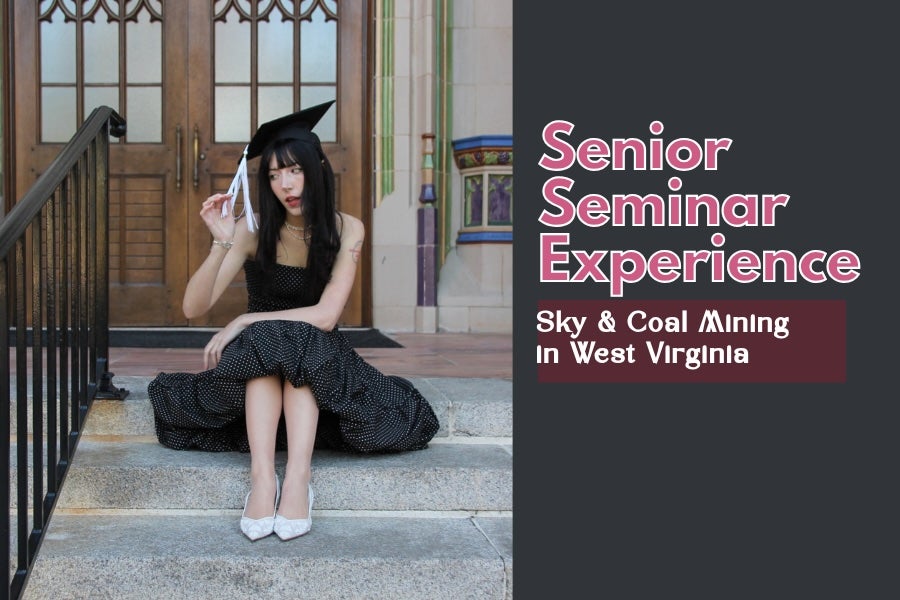
Skylar graduated with a B.A. in History in Fall 2025. In her last semester, she took the senior seminar class with Dr. Ronald Doel on the theme of "Reconstructing Historical Landscapes." The senior seminar is a capstone course that every History major gets to take. Students research and write an article-length paper on a topic of their choice. FSU History social media intern Tessa talked with Skylar about her senior seminar experience.
Tessa: What was your senior seminar topic, and how did you choose it?
Sky: My senior seminar was on historical landscapes. In class, we discussed how you can research history through reading and analyzing different landscapes. I chose to work on coal mining in West Virginia. The title of my project was “Conversations with Death: The Socio-physical, Ecological, and Historical Applications of the Coal Mining Industry on Appalachian Community.” I explored the cultural, political and economic dimensions of coal mining in West Virginia, combining local culture with landscape studies.
I chose it more because of Dr. Doel, the instructor, rather than the topic itself. That was the advice I had been given by other History seniors. The senior seminar is such an intensive project, it is important that you have a good bond with the professor because they are the person who is going to help you. History can always be learned, but the bond with your professor cannot be learned.
Tessa: Did you know a lot about your topic before you started the seminar?
Sky: I was familiar with the history of the Appalachian region as it has been my main area of study in American history, but I knew nothing about coal mining. The only thing that I knew about coal mining was one photographer I really liked, who did historical photographs of old coal mines. I used some of her work in my project. She had a series of photographs that covered the workers' union in 2007. I used those to talk about how coal miners’ unions have not gone away because the need for them has not gone away.
Tessa: What other sources did you use?
Sky: I had some issues gathering source material. Working on coal mining in West Virginia, which is a largely rural area, it was hard to get my hands on physical sources rather than downloading them from the internet. A lot of the time, I had to reach out to librarians in West Virginia and ask them if they could go into the archives for me and locate material that I needed. Altogether, with primary and secondary sources combined, I had 25 sources.
There was one source in particular that I really needed, which was published by the union workers for coal mining. They had their own newspaper, and there was a specific issue from 1950 that I wanted. It was not available anywhere online, and the only way I knew of its existence was through another news article from that time that referenced a poem from it. I had to contact the United Mine Workers of America Collection & Archives to get this issue.
Tessa: Did you have a similar topic to other students in the seminar?
Sky: We definitely had areas of overlap because we were all working on the same theories. At the beginning of the seminar, we agreed on the premise that there is no such thing as “untouched land.” All of us worked on the basis that you cannot assume because it is wilderness in our period, that it has always been wild. For my project in which I researched coal mining in West Virginia, I knew that there had been plenty of Native American groups that were using that same land before people moved into the Appalachians in the mid-1800s to exploit the area for coal. Additionally, there were other students whose work touched on Native American pasts in the same land, so there was overlap there as well.
Tessa: How did the feedback you received influence the direction of your project, especially when it came to peer review?
Sky: The senior seminars for History are very small; there were 12 people in mine. This made it feel very intimate in the way we went from person to person to give proper critiques to everybody. The thing I found most helpful was Dr. Doel’s comments. Even when he was telling us that it would not be useful to explore in a particular direction, he always offered alternative paths to investigate. A lot of students are concerned that when they go into their seminar they will be told "no, that’s not right," without any suggestion of how to move forward. That they have to go figure out what is right on their own. That was not my experience. Most of the time, one of your peers or the professor will step in and say, well, that is not the best way to approach this, but here are three other ways you could go.
Tessa: Tell me about the writing process. Did any of it surprise you?
Sky: We had to write a paper of about 10,000 words; that was our cutoff. That was really intimidating. The one thing that surprised me was just how fast it got written. You spent four straight months focusing on one single topic, reading so much source material that surrounds that one topic, that by the time you start writing, it goes by so much faster than you are expecting it to.
Tessa: What advice would you give to someone taking the senior seminar?
Sky: Do not feel guilty for stepping away from the paper for a while. If you feel like you need three days during which you do not even look at a single source or at the paper itself, if you want to close out all the tabs and walk away, and act like the paper does not exist, do it! It helps a lot. Sitting there and burning out is just going to come back and bite you. In the very beginning of the semester, you will have a lot of energy, and then as you get closer to the end point, you peter out. When that happens, you will be tempted to write whatever to get to the word count, and your last three paragraphs will not be a good representation of your work. So, just take some days off, do not look at the work at all, do not think about it, and then come back to it.
Tessa: How was the senior seminar different from other FSU History courses?
Sky: The main way that the senior seminar is different is the time span covered. A lot of other History classes at FSU cover a century, or centuries, of events. You are working on a broad scale. With your seminar, you focus on a single event or theme and look at it under a microscope. You will get familiar with that topic in a way that you wouldn’t be able to in other History classes. On top of that, because of the small class size, you have time to ask a question that might take 20 minutes to answer.
Tessa: What were you most proud of in your final project?
Sky: The fact that I got it done. The entire seminar, I was thinking, “No way, it's not going to happen, I’m not going to finish this thing.” It never felt real until the moment that I had put in that last source in the bibliography. And then I thought, “Oh, wow, it's actually done.” Being able to say that you've done your best work is a really rewarding feeling, and that’s what I was most proud of.
Tessa: How did the senior seminar change your views on what historians do and History as a subject?
Sky: Dr. Doel is such a great professor. The way he brought history to us was from a perspective that I had never seen before. He did it from a "nothing is finite" perspective. What I mean by this is that he never wanted us to just say things without an explanation. A lot of history sometimes feels like just stating facts. He wanted us to approach history from the perspective of "I know that what you are saying is true, but why do you think that it is true? And is it true from all human perspectives? How can we think of it differently?" He approached history as a humanist, focusing on the lived experience. We cared so much about the people and their perspectives that we were studying that I never thought of them in terms of a population, I thought of them as individuals.