
#SeniorSeminar Interview: Alexandra Calbough & “The Windover Archeological Site: What can it reveal about the Relationship Between Early Archaic people and the Florida Landscape 7,000 to 8,000 years ago?”
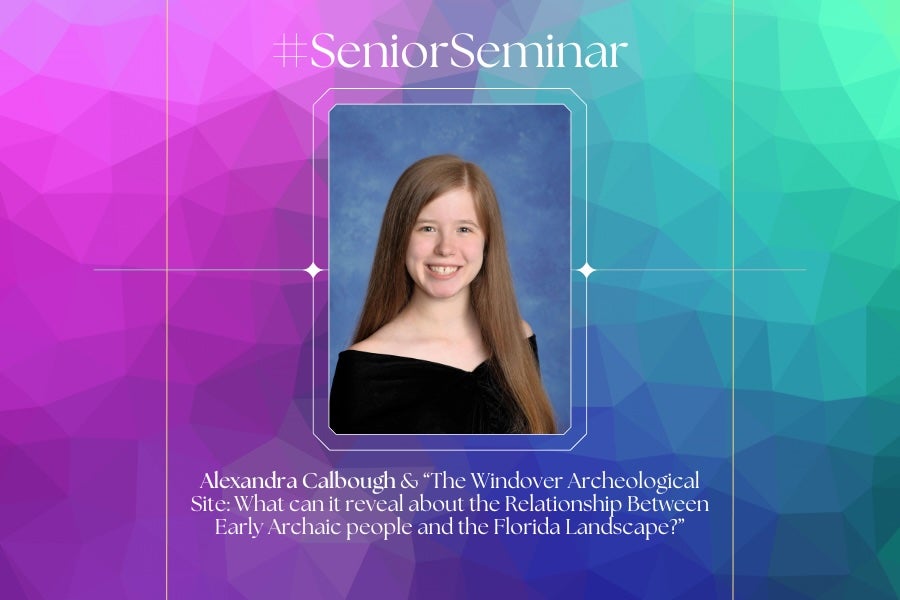
History has always been one of my favorite topics. Unlike math and science where you must apply formulas and equations, or English, where you need to follow grammatical rules, history is very much about understanding how we came to be as people, how societies formed, and what values they were formed on. That has made history something I have always been interested in.
I am mostly interested in American history, especially Native American history and how America became an independent country. I am also interested in how laws and customs adapted to the changing needs of the people throughout the country’s history.
What I like about FSU is that it has an emphasis on liberal arts. I first came to FSU on a field trip in middle school, and I enjoyed the way the campus felt and looked and wanted to be part of the FSU atmosphere. I came in as an exploratory student, and at the end of that program, I decided to major in History. I looked at the major requirements, the courses that were being offered, and I thought, “This is very nice. The department isn’t too big, but it offers a lot of different kinds of history.” All the teachers and the classes have been great. You see the same faces in the classroom, which has made studying history even more fun.
Why did you choose this specific senior seminar on the impact of landscapes on history?
I was born and raised in Titusville, Florida, near the Windover Archeological Site. In the 1980s, while clearing land for a housing development, the skeletal remains of 168 people were found, the Windover bog people. It is believed that these people lived about 7,000 to 8,000 years ago during the early Archaic period. It is something I have known about growing up in Titusville and combined with my interest in Native American history, I decided to make that the subject of my senior seminar project. I wanted to investigate how these early Archaic people of America lived, and how they interacted with their environment.
The theme of the class was historical landscapes. I asked Dr. Ronald Doel, the professor, if I could explore how the early Archaic people interacted with their landscape based on the evidence found in the burial site. The Windover people were purposefully buried in a pond and were wrapped in cloth which was staked to the ground. Most of the people were buried on their left side in the fetal position, with their heads pointed west and their faces pointed north. The ground was very peaty, which helped with their preservation. The peat also made the ground mushy in the late summer and early fall months, which is when most of the bog people were buried, indicating that they knew about the shifting qualities of the land they lived in.
The interesting thing is that because the bog bodies were so well preserved, brain tissue and stomach contents were found in a large number of the bodies. Once the dig itself was finished, the site was filled back in and marked with a historical marker. There is no Windover bog people museum but some of the remnants are on display at the Brevard Museum of History and Natural Science in Cocoa, Florida.
What kinds of sources did you use for your project?
Most of the material I used were secondary sources written by people who had worked on the dig site themselves or had extensive knowledge about the subject. I used sources that talked about the Florida environment in the mid-Holocene period, subsistence practices inferred from stable-isotope and archaeobotanical evidence, other burial sites across Florida, and ones that were specific to the Windover site itself. The bog people who lived 7,000 to 8,000 years ago left no written evidence, so all that we can interpret about their past are from their bodies and the burial site itself.
An examination of the stomach contents showed that the food the people had consumed could only be grown during a specific time each year, in this case, late summer and early fall. That meant that these people did not live at the Windover site year-round but that it was a semi-permanent base to which they returned at a specific time of the year. One other thing that was discovered was that the Windover people’s diet relied heavily on freshwater animals like ducks, catfish, and turtles along with small mammals and a variety of plant foods like fruits and seeds.
Another finding from the stomach contents is that the people took medicines, and that they were treated for their sickness before succumbing to it. Some of the bones showed signs of arthritis and fractures, but this was not the reason for their death. From this we can deduce that the early Archaic people lived in a community where they cared for each other and looked out for those who were old, sick, or weak.
Something else that was found at the site were grave goods. Men were buried with crafting, processing, and hunting tools, women with bone tubes, turtle-shell containers, shark-tooth scrapers, shell necklaces, and small textile bags, and children with woven textiles, indicating their roles in society. The fabric in which the bodies had been wrapped prior to burial are among the oldest examples of manufactured cloth in North America.
How did you get started with the project?
The first thing I did, after I got my topic approved, was start searching for sources on JSTOR and other online sites. I wanted to see what was available before working on the structure of my paper. I decided to have sections on the Florida landscape, the climate at the time, the role of the bog, migration, community life, and burial practices.
Beginning the writing process was hard. I had several rough drafts, but I did not like any of them. I wrote stuff down but then decided that I did not like it or that it was irrelevant. I started and restarted, several times. Then during Thanksgiving break, I was finally able to put everything together. I gathered all the notes I had taken on one topic together, for example the mid-Holocene, and organized them, and then turned them into a part of my paper. Then I moved onto the next topic, in this case, cultural practices, and I incorporated that into my paper. I ended up with four big sections: the Florida environment and landscape in the Early Archaic, human settlement at Windover, the social and ritual implications of the burial practices, and life and adaptation to the wetland landscape.
What surprised you when you did your research?
There were a couple of things. On the one hand, how much information we can gather from bodies or objects without any written primary sources. Like, the Windover people lived there only in late summer and early fall, they treated their sick with medicine, herbs, and berries, and they looked after those who had health issues. That really surprised me.
The other thing that surprised me was that the evidence suggests that the Windover people cared about each other. They buried each other individually in a purposeful way. They provided grave goods and placed the bodies in a certain direction, which means that they also had some idea of what might come after death. They cared about their people just like we do today. That’s what really struck me that people of the past think and behave very much like the people of today. They were human beings, we are human beings, and the misconception that they were backward or did not know much is wrong. They understood the land enough to be able to use it to their maximum benefit. They went to places where they knew they would get food and shelter. They knew their climate and their environment without Google maps or the Weather Channel.
What advice would you give to History majors preparing for the senior seminar?
Pick a topic that you love and enjoy, because this class requires a lot of work. Find the senior seminar theme that you like and then choose a research question within that broad topic. The first topic that I had selected early in the semester just did not click with me when I started to look more into it. So, I asked to change my research topic to the Windover bog people. I am happy with that choice; I enjoyed the research and feel that I am a bit of an expert on the Windover site now. I enjoyed the conclusions that I drew from my sources – and I wrote a 15-page paper!
The senior seminar was always the most daunting part of the History major to me. The fact that I had to write a long paper seemed scary. I also doubted myself a lot: will I be able to do this? This isn’t a regular 1500-word paper you have to write for a W class where the teacher gives you the topic. This is a research paper, in which you have to go in depth into a topic, in which you frame the question and set the boundaries of your research. That is why it is so important to select a project that you are passionate about.
When you do take the senior seminar, don’t overlook the most important resource which is your teacher. They have office hours, go to office hours. They have email, reach out on email. Your teachers are there to help you. Don't be afraid to contact them. They are not going to bite. They're going to help you as much as they can because they want to see you succeed. And especially in a class as small as a senior seminar, where your instructor will get to know everybody.
What’s coming next for you?
I graduated with a double major in History and Criminology in Spring 2026. I am planning to move back home and pursue a paralegal degree combined with an internship. I have been thinking about going to law school, but I don’t know if I really want to do that right now. Law school costs a lot of money, and I want to see first if I like the law enough to put in the work. Doing a 12-months paralegal course online will allow me to work in the legal sphere, and if I fall in love with law, I’ll go to law school later.