
#SeniorSeminar Interview: Jeff Lubinski & “Ebbing Tide: British Disengagement and the Reşadiye Affair in Ottoman-British Relations”
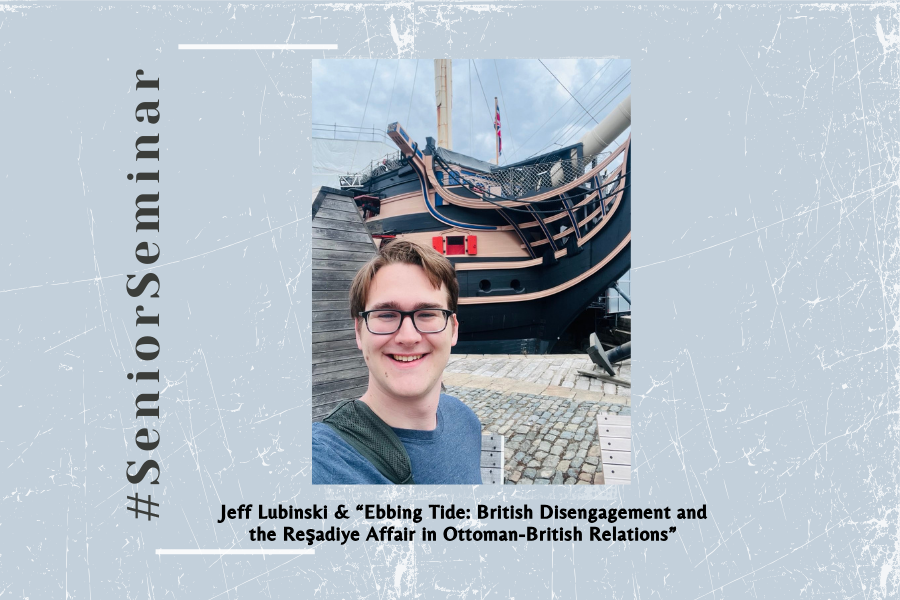
I have always been interested in maritime history. For my Honors in the Major project, I looked at the relationship between Great Britain, America, and the Ottoman Empire in the Mediterranean between 1820 and 1850s. For my senior seminar paper, I wanted to do something adjacent, something that broadened my horizons but was not directly connected to my HITM project. I decided to work on the Ottoman attempt to rebuild their navy between 1900 and 1914. Dr. Özok-Gündoğan had been highly recommended to me as a teacher, and I really wanted to take a class with her. The senior seminar on the Middle East in the colonial period was the perfect topic for me.
What's the specific question that you were exploring?
I was curious about Britain’s role in the Ottoman Empire’s attempts to rearm themselves. Ottoman rearmament began in 1908, and in 1911, Great Britain became involved in it. Most scholars have looked at Germany’s role in the Ottoman rearmament, mainly because the Ottomans joined their side I World War I. In 1911, the British sent a naval mission to help rebuild the Ottoman navy and train crews. In 1914, they had begun to build two dreadnoughts for the Ottomans. However, because of the outbreak of WWI in August 1914, Britain kept the dreadnoughts for itself.
A lot of historians have downplayed the effect that this decision to not deliver the dreadnoughts had on the Ottoman policies. From what I found, though, it was the final nail in the coffin of the British-Ottoman relationship and pushed them to ally with Germany. One of the dreadnoughts was called the Reşadiye. This ship became a national icon for the Ottomans. They held crowd funding events in which ordinary people donated their money to allow the empire to purchase this ship. When Britain seized the vessel, that was seen as stealing a cultural symbol from the Ottoman empire.
Great Britain’s naval policy was to have a fleet larger than the combined fleets of other nations. And with Germany building up its navy, they had to increase the size of their fleet drastically. When WWI broke out, they tried to take as many ships as they could to prepare for war. At the time, Winston Churchill was the First Lord of the Admiralty, and he ordered the seizure of the Ottoman dreadnoughts. For Churchill the needs of Britain overrode the rights of other countries.
The Ottoman government protested and spoke out against this seizure of their ships, but in the end, they pressured Germany into giving them two ships to replace the ones confiscated by Britain. This was one of the reasons that Ottoman Turkey joined the German side in the war.
What sort of sources did you use for your paper?
I looked at newspapers both Ottoman and British. The British papers barely mentioned the fact that the two dreadnoughts had been commissioned and paid for by the Ottoman empire. I looked at Churchill’s personal papers and letters as well as documents covering the hearings in the House of Commons. I found in each of those sources that the British were very indecisive on how to handle their relationship with the Ottoman empire. One source described the British policies towards the Ottomans as a “bundle of contradictions”.
What surprised you about the material you worked with?
I think what really surprised me was how Eurocentric many earlier historians had been on this topic. In their books or articles, there is almost no mention of the seizure of the two ships, and when it is mentioned, then mainly in a footnote. That surprised me too, how the telling of an important story is left to a footnote. Some of the more recent histories have begun to point to this event as a pivotal moment, but even then, most downplay how much this incident influenced Ottoman allegiances during WW I.
What was the most challenging aspect of writing your senior seminar paper?
I would say there were several things. On the one hand, I was researching and writing my Honors in the Major project at the same time, and it also involves the Ottomans and naval politics in the Mediterranean. Just a century earlier. Keeping the two stories separate was hard at times, but I still enjoyed it- I just love naval history!
The senior seminar topic was narrower than the other one which made it easier to think about. Finding non-British primary sources was a challenge which meant that most of the documents I worked with were British. That made finding a balance between the two more difficult. But otherwise, the project flowed very well. Dr. O-G kept us on track with our work and helped us pace ourselves. Nothing ever felt like a monumental task. It just felt like adding one more part to the bigger piece.
I really enjoyed doing the historiographical part of the paper. That was a lot of fun getting to see the growth of discourse on my topic throughout the decades. In the end, even though this is an undergraduate paper, I felt like I was adding one little more tidbit to this topic.
How did you manage to stay on top of all the work?
I did my senior seminar and my Honors in the Major project during the same semester, and I had three other classes. For my regular class work, I sat down between class periods or spent a day just devoted to those. The rest of the week, I tried to work on the senior seminar and the HITM project. I tried to use my free time, whether it was 30 minutes or two hours, chipping away at the research work. Doing something every day made the workload doable.
In my time in the History program, every single class taught me at least one valuable skill, as a historian, a student, and a writer. The senior seminar taught me how to analyze and synthesize sources and write more professionally. For a regular class paper, I might work with only four or five sources, but for the senior seminar I used more than 20. Now that I have completed a 17-page paper, I feel that my HITM paper is very doable. Researching and writing the senior seminar paper has given me confidence that I can do the bigger project too.
How did the presentation of your work go?
I felt it went very well. It was fun because everyone in the class got to share what they had been working on for the whole semester. Putting the presentation together was a great way for me to check that I was still on track with my work before I submitted my draft. Condensing my work into 10-min presentation was almost like making an elevator pitch of the entire paper. Because everyone was enthusiastic about sharing their work, presentation day was the best day of the whole semester.
What advice would you give history majors when they're looking to take a senior seminar?
Don't dread it. I dreaded it. But this was hands down, the most fun class I've taken. The senior seminar is something to look forward to. You should find what historical topic you love and let that guide you, even though you should keep an open mind to working on a subject you had not thought about before. Coming into your senior seminar with passion will make it a fun time. You will be busy. It is going to be a lot of work, more than you might have done for any other class. But by the end of it, you will feel proud of what you have accomplished.
What’s coming next?
I just graduated (Spring 2026), and I will to to graduate school next. I am planning to pursue a library and information science degree with a focus on archiving. Both the Honors in the Major and the senior seminar introduced me to working in archives and made me realize what tools I wish I’d have access to make my work easier. In my future career, I would like to make materials more accessible to researchers.