
#SeniorSeminar Interview: Justin Milledge & “Botanical Gardens as Landscapes in Nineteenth-Century America”
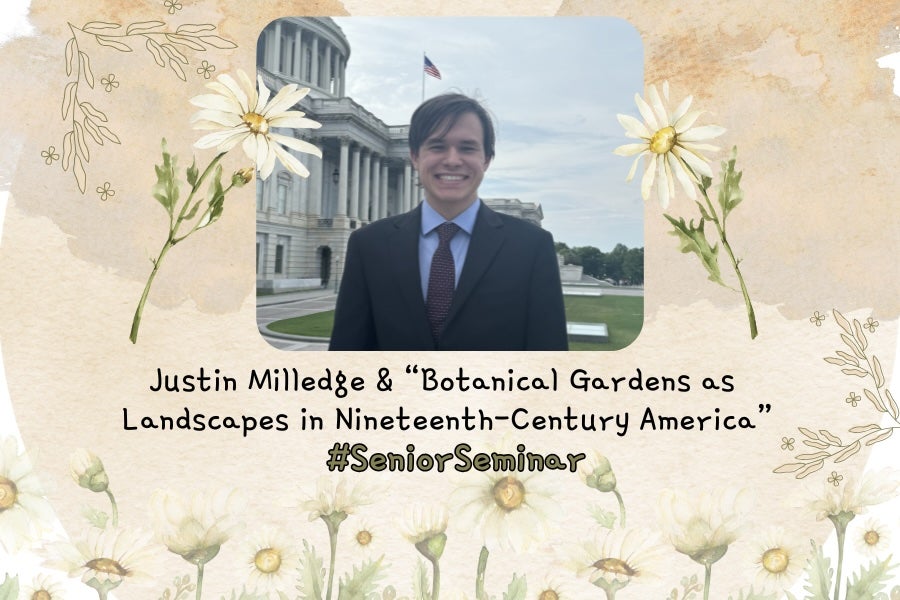
I am a History and political science double major with a psychology minor. I have been interested in history since I was a little kid. History runs in my family. My grandfather and grandmother told stories from their younger days which I loved to listen to. My grandfather was a lawyer and prosecutor; both he and my grandmother attended the 1968 Democratic Convention in Chicago as delegates for Senator Eugene McCarthy. I have always found history fascinating. It helps with connecting to other people because you learn about people’s lives and motivations. You can understand better how people think.
When I was little, my father and I used to visit a lot of Civil War battlefield sites which are beautiful pieces of land nowadays despite the carnage that went on there. Because these are protected places as historical landmarks, they are some of the most picturesque fields I have ever seen. That’s one of the reasons I took Dr. Doel’s historical landscapes senior seminar.
I decided on Florida State University after my campus visit. I loved the campus — how intentional the landscaping was, and I liked all the brick. I could see myself being very comfortable here, both living and studying.
What specific topic did you work on in the senior seminar?
I researched the early history of American botanical gardens, primarily starting from around the mid-18th century going into the 19th century. I like gardening; it is good for me to step away from people occasionally and to get my hands a little dirty. For the last six years, I have also been involved in creating butterfly gardens. All this makes me appreciate botanical gardens. My favorite one is the National Botanical Gardens in D.C.
I had taken some classes with Dr. Doel before the senior seminar: History of Energy, Environmental Policy, and Cold War Science. I knew his way of teaching, especially the types of sources he used and how we analyzed them. When I mentioned my interest in gardening, he suggested I look into the history of botanical gardens in the U.S.
What are you arguing in your paper?
American botanical gardens started out as a sort of citizen science, like most early sciences in the 18th century. Botanical gardens were created by individual landowners. A number of the founding fathers, George Washington, Thomas Jefferson, had their own botanical gardens. The most significant of these early gardens was Bartram’s Garden in Philadelphia, the oldest surviving botanical garden in North America. Founded in 1728, the garden holds a number of plants that are extinct in the wild, like the Franklin Tree. The early gardens were all run as family affairs and passed down from father to son. It is only later that gardens were run by scientific institutions like universities.
An enduring question was: what makes a park a botanical garden? Nathaniel Lord Britton, one of the founders of the New York botanical garden defined it at the end of the 19th century as one which has an economic purpose, a philanthropic purpose, a scientific purpose, and an aesthetic purpose. Based on that definition, he found only ten such gardens in the U.S. at the time. We see a shift throughout the 19th century in the intentions and layout of botanical gardens. In the early 1800s, there was an emphasis on the aesthetic and the scientific value of the garden.
The early botanical gardens usually followed the two gardening styles called ‘picturesque’ and ‘gardenesque’ which were imported from Britain. The picturesque was trying to emulate a picture-perfect scene with a bit of jaggedness and an intermixing of plants: trees, shrubs, flowers, all put together to produce a meadow as we see in paintings. The gardenesque style became more common in scientific gardens; it emphasized the individual natural beauty of a plant. While these two styles could work together, the landscape architect decided which to employ — whether he was attempting to create an aesthetic or artistic garden or more of a scientific garden. Over time, we see a shift from the picturesque to the gardenesque design of botanical gardens.
What sort of sources did you use for this type of research?
I used a lot of contemporary scholarship, for example, Andrew Jackson Downing's book, "A Treatise on the Theory and Practice of Landscape Gardening, Adapted to North America," which was published in 1841. The other interesting piece was Britton’s article on the history of the U.S. botanical garden, written in 1896. It helped me understand the attitudes of people towards gardens at the time. I also used a lot of drawings and sketches of some of the layouts of the early botanical gardens. I found an issue of Harper's Weekly newspaper which displayed the central pavilion of the U.S. Botanic Garden. This detailed on the one hand the very large central chimney that ran through the greenhouse to keep the temperature up, but also that at the time people liked grouping plants together based on variety, creating a fern house for example, or an orchid house. That was very typical of the time, to display variety and divergence in Darwinian evolution, but now it's more common for botanical gardens to try to feature one specific ecosystem per greenhouse.
Most of the material I used I found online, either through databases like JSTOR or Google Scholar. The FSU library also held some material. But much came from the surviving botanical gardens themselves. Many had online collections of historical photos and records. I have only visited one of the gardens I wrote about, the United States Botanical Garden in D.C., but I’d certainly like to visit some of the others.
How did you get started with the project?
This is probably the longest paper I have written, but also one of the easier ones, simply because I liked researching it. It was very fun. Dr. Doel had given me a lot of inspiration about what sources I should use, especially because he placed a lot of emphasis on visual sources from the time. I found all my sources first and wrote down what each source said. Then I made an outline and plugged the sources in where they fit. The hardest part for me was constructing the argument.
As often as possible, I went to coffee shops and worked there for a couple of hours, combing through the sources. I’d ask myself: what kind of picture are the sources painting? How is this shaping my argument? Often, I followed one avenue, then chased down another source, I moved back and forth between different components of my paper. And gradually throughout the semester, the whole paper came together. A lot of my college experience has been figuring out how best to work, and I found that this zigzagging is most effective for me.
Writing the paper itself was not that difficult, I did most of it over a couple of days. By that time, I had fully formulated my argument in my head. Our class presentation was especially helpful. I had to translate my thoughts into a coherent speech, bringing out all the connections and lining up my argument. It made me realize where I wanted to do a bit more research. And, of course, my topic is very visual, which made the presentation more fun.
What surprised you most in your research?
I was surprised by how many failed attempts at botanical gardens there were. That was the big surprise. I was also struck by how much variety there was in the layout of the gardens, how much artistic and personal choice influenced the different gardens. Especially when looking at the very first gardens. But even later in the 19th century, when gardens get bigger and more capital-intensive, many are still the passion project of a landscape architect who often stayed with the project for decades in order to shape the landscape to their design.
Gardening has always been a very personalized process for me. It's very much a reflection of the person themselves and their tastes for what they want their garden to look like and what they want people to see. I liked learning that it was a similar experience throughout the history of gardening for other people. On a personal level, I felt connected to and understood instinctively what I was reading about. This was the first time engaging with an historical topic where I had such an ability to empathize with the people on the page. That was special to me.
What advice would you give to other History majors who are about to take a senior seminar?
My advice would be, I think the best thing you can do is find something to write about that you really love. A lot of times when people approach assignments, they think, I just need to figure something out that fits and don’t give it much thought. But I found that when you're writing a long paper, mine is 21 pages, you want to work on something that you really like. It makes it a lot easier to stay motivated to create something that you are proud of.
My other advice is: start your research early because that is the hardest part, digging and finding sources. Make the beginning of your project as unintimidating as possible, Google around, look at the databases, consult the library (I love going to the library stacks and taking the physical books in my hands and mining them for material). Read some sources, take some notes, and follow your instincts. Slowly you will get drawn into your project