
Life after Bellamy: Insights from James Cortada (FSU Ph.D. 1973)
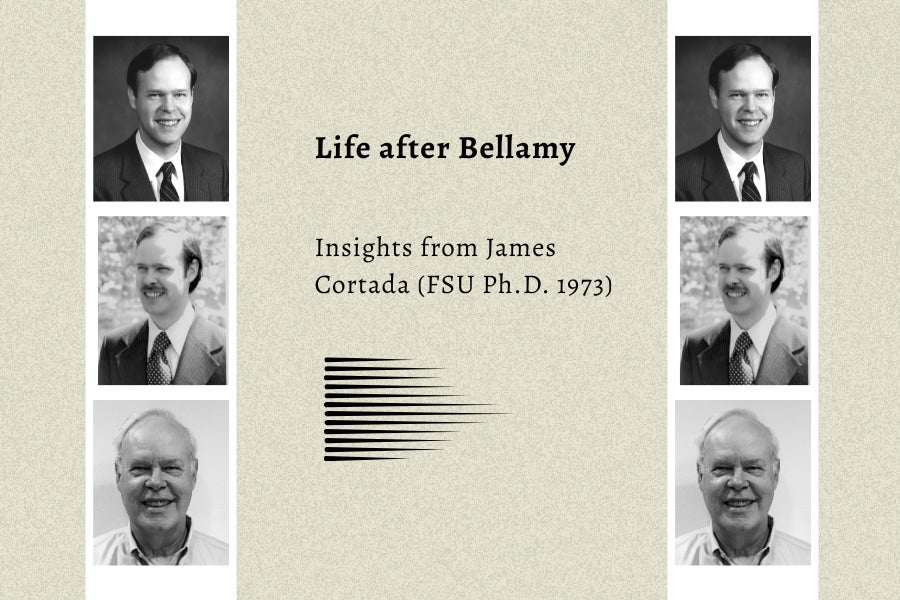
I completed my Ph.D. in modern European history in 1973 and because of the severe shortage of teaching jobs decided to find a path in a new industry. In my case, computing at IBM — then considered one of the top five companies in the world. I retired from IBM in 2013 after a career in sales, management consulting, and even as an executive.
While pursuing that career I continued to write history books, beginning with my dissertation and followed by two dozen others. These were published by Princeton, Oxford, MIT, Columbia and a raft of trade houses. Plus, over 125 refereed articles. Publishing was a hobby nurtured over the past half-century. Today I do this full time in my retirement from IBM and as part of being a senior research fellow at the University of Minnesota. During my career, I also wrote over a dozen books about business and management, made possible by all the writing experience I gained as an undergraduate and graduate student in history. Most business writers were not as thorough in their work as we are in our history research, so I saw that difference as a competitive advantage, and fun since I liked writing.
I had a fantastic experience at IBM. I enjoyed a wonderful career in one of the coolest firms. I met famous people, worked on important problems, traveled to over two dozen countries, ran multi-million organizations, and oh, the people I met: a Nobel prize winner, the guy who invented the TV remote controller, presidents of two countries, CEOs and other famous business leaders, and employees with advanced degrees from everywhere, gentle souls who solved complex business problems, and who were honorable, nice folks from everywhere. We lived in New Jersey, Poughkeepsie, New York, Nashville, Atlanta, and in 1988 landed in Madison, Wisconsin, where we have lived since. I married the lady I dated in college; we had two girls and now play with three grandchildren. My starting salary at IBM was the same as a tenured associate professor and within five years, as much as the chair of our history department.
There are lessons to draw from my experience. You can find your happiness wherever you go with whatever you do. Selling was as much fun as lecturing, solving a customer’s business problem just as interesting and intriguing as answering a tough history question. All required making sense of circumstances, understanding context, forming points of view, and expressing these in persuasive ways. We students learned how to do that without realizing that these were skills transferable to anything else we did in life. It mattered less what courses I took and more what skills I sharpened.
Handling ambiguity, prizing context, thinking historically, and communicating well in collaborative ways ultimately should be what we feature on our C.V.s and job applications. I learned that studying history was a means for sharpening those more important tools, that working outside of history does not mean abandoning it; this is not an either/or decision. It is a celebration of being flexible, adaptable, and open to new possibilities. I came to realize that by the time I left FSU I was equipped with the skills and courage to work in a world-class company, to look into the eyes of senior public officials and business executives to urge what they needed to do. Confidence and a positive attitude proved essential.
FSU’s Department of History was a good place for me because it was young with ambitious professors building a rigorous history program, making the grade themselves but with enough senior professors to make sure all of us were grounded professionally and personally. I want to memorialize my advisor, Earl Beck, for providing all of us with that grounding.
After IBM, we remained in Madison. Since then, every six weeks I have had lunch with Stanley Payne, who taught at the University of Wisconsin, and arguably is the most famous historian of Spanish history of the past half-century. While at FSU he facilitated publication of my first history articles. Today, I research the history of information. I wrote two histories of IBM, another about my family, several on management and engaged in community activities applying my managerial experiences. And just as much fun: Over the past half-century I have built a library of some 25,000 books, most about history. I am now donating these to academic libraries, perhaps my most enduring contribution to our field of history.
My bottom line: History prepares you for more success than we normally think possible when we are young. I would repeat my life’s journey in roughly the same way.