
An Interview with Jeffrey Lubinski, Recipient of the Dr. Edward G. Gray Award for Undergraduate Exploratory Research in History
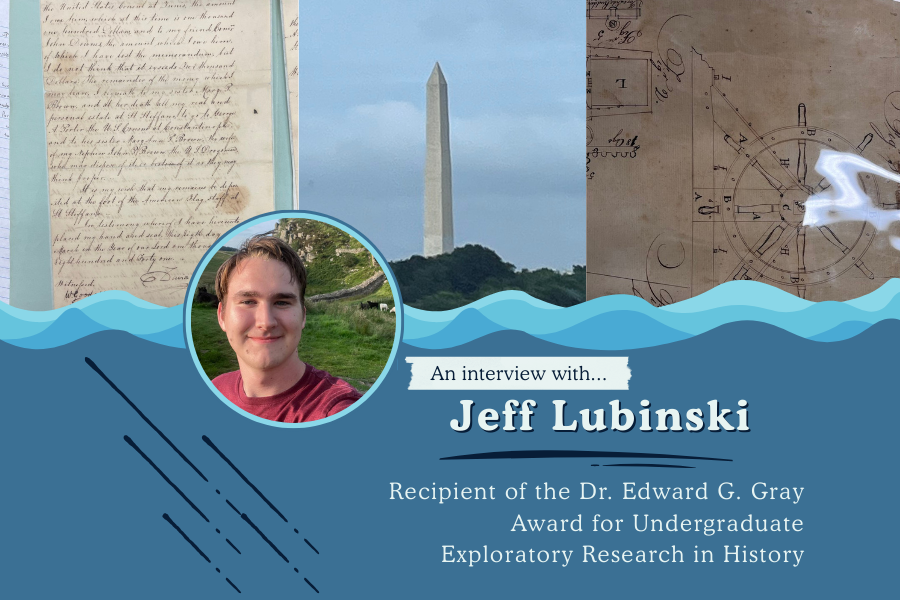
In Spring 2025, Jeffrey Lubinski received the Dr. Edward G. Gray Award for Undergraduate Exploratory Research in History. This award is granted to undergraduate students to promote their work and cover the costs of exploratory research for those writing their Honors in the Major thesis, with a particular preference for students examining United States History.
Lubinski’s Honors in the Major project is titled “Imperial Waters” and focuses on the relationship between “Great Britain, America, and the Ottoman Empire around the period of 1820 to 1850.” Specifically, he is looking into “legal disputes over maritime jurisdiction… political actions taken by America in the Ottoman Empire” and “how Britain engaged with the United States as they each had a hand in the reconstruction of the Ottoman navy.” Lubinski explains that while his high school world history teacher got him interested in maritime history initially, his renewed interest is due to "A Short History of Seafaring" by Brian Lavery, a book that spans 5,000 years of sailors and navigation across the seas of the world.
In the beginning, Lubinski’s thesis was aimed at examining “direct legal disputes” between the three nations — the United States, Great Britain, and the Ottoman Empire — but once he started his research, he realized that he could not find documents dealing with that topic. Instead, he had to pivot to a thesis that was based more in politics and the “economic history of trade between the countries” over the “legal tracking of what occurred during the time.” When it comes to a project as large as this one, crafted over a long period of time, flexibility is necessary. Even now, Lubinski says his thesis is “still developing” as he continues to examine different sources, whose content may change his perspective on his research or provide insight into an aspect of his work he previously hadn’t considered. He describes his method as a cycle of finding materials, analyzing them, and separating the information that is relevant to his topic, which leads him back to the search for more materials, always keeping an open mind if he has to return to the drawing board.
Over the summer, and with the help of the Dr. Edward G. Gray Award, Lubinski was able to access materials from the American National Archives in Maryland, the Library of Congress, and the British National Archives in London. Dr. Gray was a historian of early American history and former chair of the Florida State University Department of History. He taught at FSU from 1998 until his passing in 2023. His family established the award to continue his memory. The scholarship awarded “made the trip entirely possible” for Jeffrey Lubinski. Being the first person to ever receive the award has him feel “deeply humbled” and “incredibly moved.” Though he had hoped to take a class with Dr. Gray when he arrived at FSU, Lubinski feels that this award allows Dr. Gray to “still help him achieve his dreams as a historian,” while having a unique opportunity to carry on his legacy.
Seeing the documents that his work was based upon in person during the visits to the archives was “moving” for Lubinski. Being able to handle letters and documents bound in an old book, touched by those central to his work, including envelopes with the wax seal still attached, was “an incredible experience,” one in which he feels he was lucky to have. Visiting the physical archives, rather than solely relying on what was digitized online, made a "world of difference" in his project as well, in the access he had to certain materials and his ability to organize his thoughts. With digital archives, separate websites have their own unique ways of categorizing and tagging their materials, making the process to find appropriate resources “challenging, but ultimately rewarding.”
To organize his digital materials, and the photos he acquired during the summer, Lubinski keeps all of his resources in a master document. His Honors in the Major adviser, Dr. Will Hanley introduced him to Tropy, a free open-source software that allows you to organize and describe photographs of research material. Using the software, Lubinski could “tag photos, categorize them however you want, leave notes in the margins and notes,” making gathering his thoughts far easier.
Going forward, Jeffrey continues to collect materials to support his work, “reading it over, writing a couple pages a week on what he’s been finding and adding to the master document of what he’s found.” He hopes soon he will be able to have a fully defined thesis and combine what he has found and his thoughts into a paper for the Spring 2026 semester