
Honors in the Major in History - Flora Domitrovic & “Early Computers as a Tool for Ecologically Conscious City Planning”
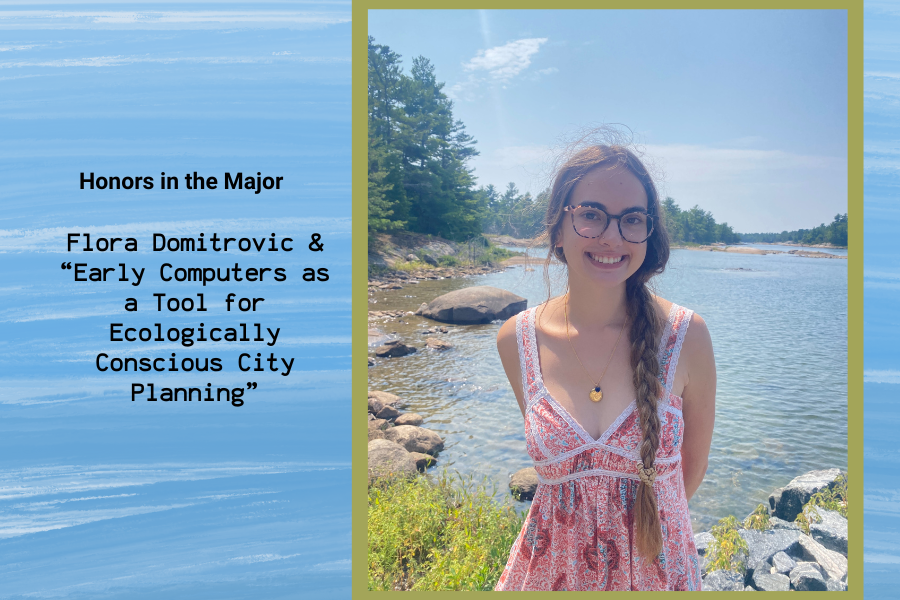
I grew up around history as there was a lot of interest in history in my family — my dad was a history professor, and my grandmother was very involved in documenting our families’ genealogy. I loved looking at past family photo albums, and I had an interest in decades like the 1950s-1980s in pop culture and how life was different. I really enjoyed my U.S. History class in high school because I felt like it explained why things are the way they are today. Something that also interested me was how technology made my life different than past generations, a theme I returned to in my Honors in the Major project. So, I suppose for these reasons at freshman orientation I chose History as my major, but I was not 100% sure if it would stick. Now as a senior, I am very happy with my decision to study History, and I’ve added minors in Urban and Regional Planning and Spanish.
Two of my favorite topics in history are the history of science and technology, and urban and environmental history, how landscapes have changed over time. I combined these interests for a paper I did for a history of science class, in which I researched some of the Cold War technologies that laid the groundwork for the following development of geographic information systems (GIS), which are the technologies behind computer maps. I also had this interest because I had been learning about GIS through my UROP project and GIS coursework. For my Honors in the Major project, I wanted to keep working on a similar topic in a later time period and examine the societal impacts of the emergence of GIS.
Two summers ago, I was an intern with the Planning and Regional Development Department at the Port Authority of New York and New Jersey. This department conducted a lot of regional transportation modeling, and I had the opportunity to work on projects using computer tools such as mapping software and coding to create analyses of regional transportation issues. My manager told me about some of the first computer transportation models used in the region in the 1950s to plan for growing traffic demand. This experience contributed to my interest in how computers were first used in urban planning.
Narrowing down my HITM topic was a process. First, I wanted to research a timeline of how GIS was created. But there was no existing literature besides retrospectives from some of the computer scientists involved in the project. Most of these retrospectives were very technical, and so it was a challenge to identify their wider implications.
Here at FSU, I have taken several GIS classes that ended up helping me in my thesis. Specifically, Remote Sensing, which was about aerial and satellite imagery and analysis, and Applied Spatial Statistics, which looked at simulative statistical models that could be applied to a map. I feel like having to grapple with the actual technical concepts behind GIS made it easier to understand what some of the technical papers and reports were talking about (even if I didn't understand everything).
Second, some of the retrospectives mentioned that environmental regulations were a motivator for creating GIS computer programs. So, I decided to research how this happened, how environmental legislation led to GIS. But there were very few sources. So, this topic proved difficult, too.
And then I came to my third project idea – and that is the one I settled on. The title is “Early Computers as a Tool for Ecologically Conscious Urban Planning.” In my previous research on GIS history, I had come across the name Ian McHarg repeatedly, whose ideas were cited as an inspiration of GIS software developers. McHarg is recognized as popularizing an ecological approach toward landscape architecture and city planning, through a comprehensive ecological inventory which utilized extensive mapping, first manually, then using computers. Incidentally, he was part of the initial planning team for The Woodlands, Texas, a master-planned community, in which many of his ideas of ecological planning were implemented. I lived in The Woodlands as a child. I grew up in The Woodlands, and my high school mascot was even a nod to McHarg’s Scottish nationality (The Highlanders). When I first came to FSU, I wrote a paper about the urban planning of The Woodlands, which was where I first encountered McHarg. It was such a cool full-circle moment to come back to this research in my thesis.
I followed up on McHarg and discovered that his papers were at the University of Pennsylvania, where he had taught. I began to focus on researching the quantitative methods for urban planning that were used from the 1960s onward – something new as city planning previously was viewed as an extension of architecture and design. I also found out that there was an archival collection dedicated to GIS in the Library of Congress. That’s when I applied for and was awarded an IDEA grant which allowed me to visit both archives over the summer.
I stayed in Washington, D.C., for five days to work in the Library of Congress. I worked in the Geography and Map Reading Room on material from the History of Computer Cartography and Geographic Information Sciences Archive. The collection consisted mainly of conference papers and published proceedings, none of which had been digitized. The archivists were super helpful in bringing out all the boxes I needed. And since I worked in the map room – even though I wasn’t looking at maps myself, there were people who worked on very old, giant maps, which was really cool to observe. And during my five days in this archive, I also found the material for my earlier (abandoned) research questions.
The collection of Ian McHarg’s papers was quite extensive. He was a professor, but he also had his own practice, and the collection contained his letters, his writings, and a lot of plans for the projects he worked on. I got to look at hand-drawn maps where you could see every marker stroke. I also looked at the plans for The Woodlands, and I could see the ways they used a computer for the mathematical methods involved in planning that project.
I took a lot of photos of the documents during my research trip, which I had to evaluate when I got back. I used the source notetaking recommendations from Harvard’s online “A Guide to Writing a Senior Thesis in History and Literature” and summarized each source, analyzed it with regards to my research question, then related it to my other sources. I created a web of sources. Once I had catalogued each source, I began writing my rough draft. It came to 30 pages, and I used it to make a more extensive outline. Then I wrote the final draft.
The hardest thing about the whole project was finding my research question. That’s why I took three semesters plus a summer semester to get it all done. The initial question I came up with was hard to research and very dry. I am glad that I did not give up but kept refining my question until I found this topic at the intersection of the histories of science, computing and urban planning. My mentor, Dr. Renfro, introduced me to different research methods to find archival sources and how to record what I found. His encouragement helped me throughout the whole research process!
My advice to others thinking about doing an Honors in the Major project is to choose a topic that you are curious about and want to dig into. And then, don’t give up if at first you don’t find a question that you can research. I know there were moments when things looked bleak, and I did not know if I could see the project through. But I persevered, and now I am happy with the direction things went. So, don’t give up.
The other thing I would suggest is to start the Honors in the Major project early in your college career. I was a second-semester sophomore when I applied, and if I had started much later, I would not have had the time to develop my project and apply for the IDEA grant. If you start the project before your senior year, you have time to refine your research question without coming under pressure from graduation.
Applying for the IDEA Grant was not difficult as I had already spent some time working and thinking about the project. I was able to explain clearly what my project was and what I needed the grant for. I got to present my findings at the President’s Showcase for IDEA Grant recipients. I had already presented an earlier version of the project at a Florida Undergraduate Research Conference. I am hoping to publish my thesis in a research journal.
I’ll be graduating this spring, and I am planning on doing a master’s degree in urban planning. I recently took Dr. Conti’s class on historic preservation, which I enjoyed a lot. I’d like to use my history background in urban planning both through historic preservation and understanding how the current dynamics of cities came to be. I hope that my thesis gave me valuable insights to use as a planner, because my conclusions explored the shortcomings of past optimism in more information and better technology to solve the problems present in American city planning. I think this conversation is relevant in today’s age of transition toward even more computerization with the growth of artificial intelligence.