
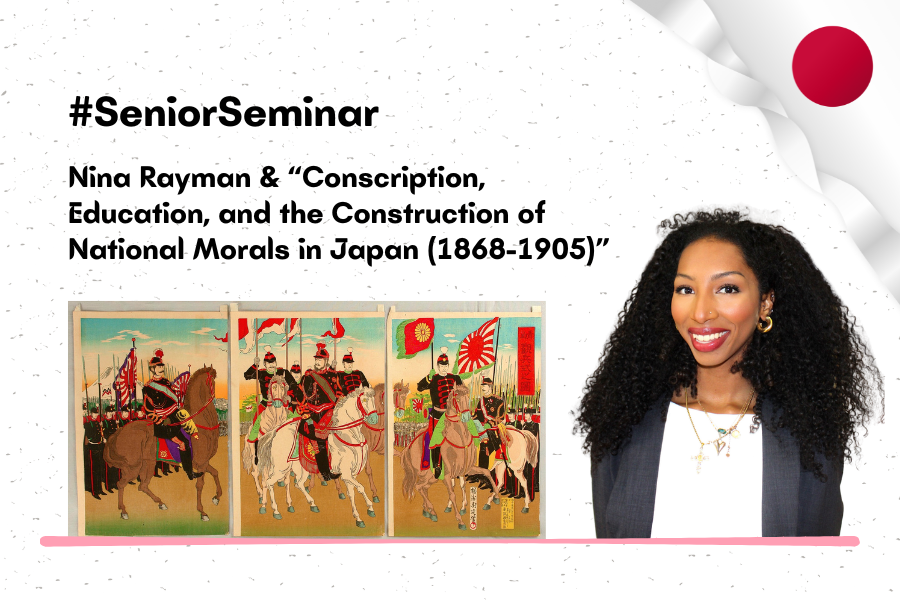
#SeniorSeminar: Nina Rayman & “Conscription, Education, and the Construction of National Morals in Japan (1868-1905)"
I have always had a general enjoyment for history, but this evolved after taking AP World History as a high school sophomore. AP World History was my favorite class, and I had an incredible teacher, who correlated distant historical events into our everyday lives. His teaching style fostered my obsession with history, especially world history and global trends. While history was my passion, I ultimately wanted to attend law school. Luckily, a history degree provides a plethora of transferable skills that can be applied to a career in law. When I chose my major in college, I initially began with anthropology to achieve a medical anthropology background, allowing me to specialize in medical malpractice in my law career. Anthropology is still my primary major, but I added History as the secondary since this subject has always been close to my heart. I am also completing minors in political science and English, as my range of interests cannot be bound by one subfield.
History is one of the best majors, in my opinion, to prepare for law school. You learn to read effectively and become acclimated to dense technical readings. Last semester, I ended up reading more for my history classes than some of my friends in law school! The History major also teaches you Chicago style of citations. I feel that Chicago is one of the best citation styles to learn as a foundation before learning the Bluebook style, which is the standard legal citation system in the U.S. I started learning Bluebook last year, and knowing Chicago has tremendously helped me with that.
Florida State has always been my dream school. I am from South Florida, but I had a third-grade teacher who went to FSU, and she would always tell us 9-year-olds about her time here. We all wanted to become Noles. Thus, going to FSU was always at the back of my head. I applied and visited during Parents Weekend as one of my friends had a sibling who was at FSU. I loved walking around the campus, and I felt, “this is the place for me. I can’t go anywhere else.” I still feel that way.
Why did you choose a senior seminar on Japanese Imperialism?
I had previously taken a class on modern China with Dr. Luo, and we covered the more recent Sino-Japanese wars. One of the books that the Dr. Luo recommended was "The Rape of Nanking" by Iris Chang. I read it, "The Rape of Nanking" following this class, and the book completely changed my life and the way I think. When I saw that Dr. Culver offered a senior seminar on Japanese imperialism, I enrolled in it with the goal of working on that topic. However, I had not taken a course on Japanese history before.
What did you write your senior thesis on?
My paper focused on educational and military reform in the Meiji period. In order to create a unified and strong Japan out of the fragments of the Tokugawa period, Japan’s leaders introduced universal male conscription in 1873. This was the foundation of Japan’s nation-building project. I investigated the shift from military power as a hereditary privilege of the samurai to it being opened to the broader male population via a new conscription system. The conscript army became Meiji Japan’s most powerful instrument of national transformation and reshaped Japan’s collective national conscience.
Conscripts received education and training as part of their military service and learned to equate military service with the Confucian duty of filial piety. From 1890 onward, all educational policies in Japan taught loyalty to the state based on Confucian familial virtues. Drawing on my anthropology training, I used Emile Durkheim’s concept of collective conscience to analyze the military and educational reforms of Meiji Japan. I show how they created new social facts or laws and norms that bound people together in the new Japan.
What sources did you use?
An important document was the Imperial Rescript on Education that was issued in 1890. I also relied heavily on the study by E.M. Osmanov who analyzed a bunch of military training manuals from the Meiji period which taught soldiers how to behave while in the military. Written in question-and-answer format, these manuals explained issues like loyalty to one’s family v. loyalty to the state. For example, one the questions read: “If your parents are sick when you are called up for reserve duty, you will go and serve your country because it is an extension of your family and demands your filial piety.”
Because I am unable to read Japanese, I began working with secondary sources first. I tried to use material from Japan’s National Diet Library, but it required an application and security clearance process that surpassed the time confinements of my course. One of my peers shared their way of searching for sources. They showed me how the reference sections in Wikipedia have links to a lot of primary sources. They also explained that if you set your computer browser setting to another country, the Wikipedia reference section might list different things. That trick helped me a lot. Within academia, there is a lot of stigma around using Wikipedia as a source. While I don’t think one should copy information from Wikipedia, it can serve almost as a reference point to find sources with more validity.
My way of researching is to keep looking for sources. Every day, I used different filters based on my changing understanding and findings, and over the weeks I found a ton of stuff. Sometimes you miss things you did not see the first time around.
How did you stay on top of writing your paper?
During the writing process, my ancient MacBook served as my tried and true. I made folders for all my sources, and I starred those that I used most. At one point, I had around 70 sources, so being able to star or double star some was really helpful. It allowed me to work with just the notes I needed for the section I was writing. I used keyword searches to find the notes I needed in the different folders. I learned a lot about my laptop!
Overall, I tend to read and take notes and highlight as much as I can. And if there are gaps in my information, I’ll research that more. The hardest part for me is developing the outline. I have to decide how to organize the paper, and what sections I need to divide it into, to maximize my argument. For every section, I write down the questions I want to answer – and this helps me clarify what I want to say in that part. I used to just do bullet points for each section but adding questions makes me treat the parts more like the short answer section in a history exam. This helps me write more purposefully, rather than brain dumping.
Last semester was a very busy paper season, as I was writing for the Undergraduate Law Review as well as doing the senior seminar. To simplify things, I utilized Durkheim’s theories for both papers, even though they covered very different topics. We had a presentation of our topic at mid semester, and while it went fine, I still had not narrowed down my paper topic by then. There were so many things I wanted to write about! I changed my mind three or four times. But we had to peer-review our essays in class two weeks before the end of the semester, and I had a draft written for that! One of the things I realized is that it takes me longer to edit my paper than to write it.
What advice would you give other students who are going into a senior seminar?
Don't overthink it. Which is what I did. While you need to take the class, the research and the paper seriously, you don’t need to treat it like it is your Ph.D. dissertation. I put too much pressure on myself, which then made it difficult to settle on a research topic.
Another piece of advice would be to start reading early. Even if you don’t take notes, just read around to get a sense of what sources are out there. Dr. Culver told us that even if you have a great idea, you can only write an amazing paper if you have sources to develop your idea. If your sources don’t speak to your great idea, then you won’t be able to write that paper. Get a sense of your source base first and see what you can make them say.
I used the Law Library as well as Strozier for my research. Remember that there are many libraries on campus, and they offer different services. The Law Library has a research center, and the staff there will help you with your research, citations and so on. This resource is open to undergraduate students until 5pm and the staff are very helpful and friendly. The Law Library also has someone that specializes specifically in citations and can answer most questions about most styles, as styles can get confusing as your writing becomes more advanced.