
History Graduate Student Association Interview with Baylee Staufenbiel, Treasurer
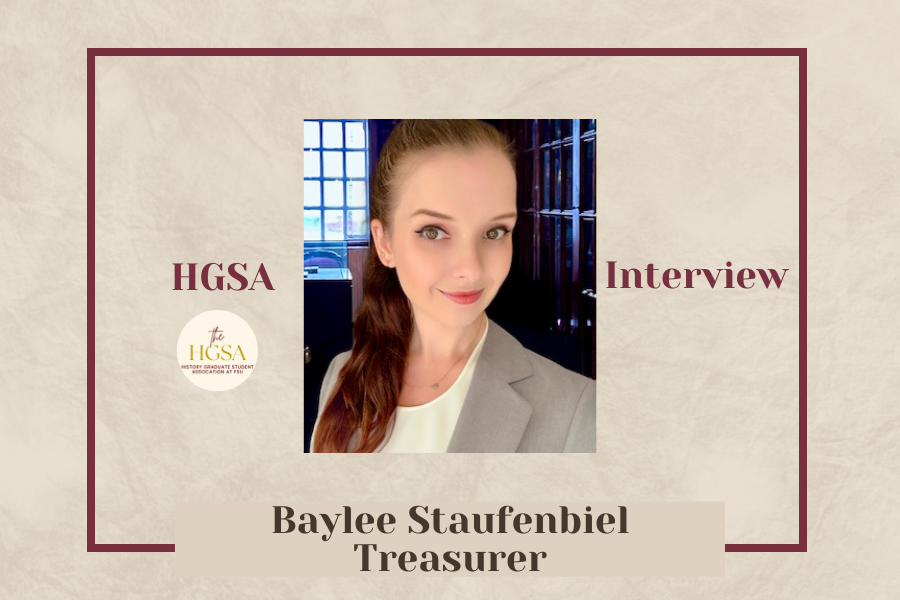
Tell us a bit about yourself!
I got my undergrad degree from the University of Washington in Seattle. I had two majors, History and medical anthropology & global health, and a minor in classical studies. After that I completed my M.A. at the University of Wyoming in Laramie, in History with a minor in gender and women’s studies.
I have been at FSU since 2020. I hold the Annabel Horward Endowed Fellowship funded by the Institute on Napoleon and the French Revolution. My major advisor is Dr. Cathy McClive. Currently, I am on the Walbolt Dissertation Writing Fellowship.
What is your major area of research?
My major area is history of science, technology, environment and medicine — I’ve always been interested in the human body. I wanted to go to medical school and work in forensic pathology. When I discovered my love for historical research and writing (and aversion to higher level mathematical work), I learned out how to blend these two fields through the history of medicine.
What minor fields did you choose?
My minor fields are gender studies, Medieval Europe and the Atlantic world.
I chose gender studies first and foremost because I study the body and I cannot do that effectively without an understanding of how gender is discussed by historians. Gender studies is where much of my theoretical framework is rooted. The field in Medieval Europe was the obvious choice because I am a medievalist. Though I straddle the line between the Middle Ages and the Early Modern, my sources are more firmly rooted in the former. Most of my primary texts are in Latin, they are written before the traditional periodization associated with the “Scientific Revolution” and “Italian Renaissance.”
I chose Atlantic world because of my interest in knowledge production, dissemination, and the establishment of epistemic medical authority. The greater Atlantic world during imperial colonization was rife with European misconceptions about Indigenous bodies and the continuous bioprospecting of local knowledge for European consumption. I wanted and continue to be interested in looking at what knowledge Europeans took from Indigenous and enslaved populations and why, what did they change, how did they change the information, how did they reconcile something Indigenous and “non-European” enough to consume, apply, mix, market, … without worrying about the destabilizing humoral side effects on their bodies? Many of these questions have been investigated by Atlantic historians of medicine, the body and science; however, I think there is more to be done.
How did your interest in history start more generally?
In childhood. I traveled with my grandparents to national parks and other places in the U.S. My mom and I also watched things together like Band of Brothers. I’ve just always enjoyed history.
What do you do for “fun” history nowadays?
I find my dissertation “fun.” I enjoy getting caught in rabbit holes that often lead me to more images or examples that I can put in my dissertation. While the process of dissertating is not objectively fun, the research and deep dives into historical topics is worthwhile.
What do you do as an HGSA officer?
I’m the treasurer. I handle the money. I develop and defend the yearly budget, sign up and coordinate Market Wednesday tabling events, do any book sales out of the HGSA office, and make sure that we have the funding available for the annual conference.
How do you see HGSA make a difference to grad student life?
HGSA fosters a sense of community, professional development, and responsibility. Organizing conferences, networking events, game nights, lunches, and other social gatherings help grad students present their research, collaborate, gain feedback, and connect with others beyond coursework. Grad school is very daunting. The HGSA attempts to minimize some of that by acting as a bridge between the faculty and the graduate students. We address grad concerns and serve as the voice of the grad students in official department meetings.
Furthermore, the HGSA allows individual grad students to step up and show their leadership among their peers. They do not even need to be part of the executive board. The annual conference, hosting a particular game night, volunteering at the Market Wednesday events, or acting as a liaison with faculty for special projects are all ways that graduate students can get involved in the department and the FSU community. The skills gained are translatable to future jobs and other applications. Really, the HGSA helps transform grad school from a lonely academic journey into a well-rounded experience where we can grow professionally and personally.
What has been the most meaningful aspect of HGSA for you?
The camaraderie has been the most meaningful. We work together, learn together, teach together, laugh together and commiserate together.