
UROP in History: The Continental Consequences of the Assassination of August von Kotzebue
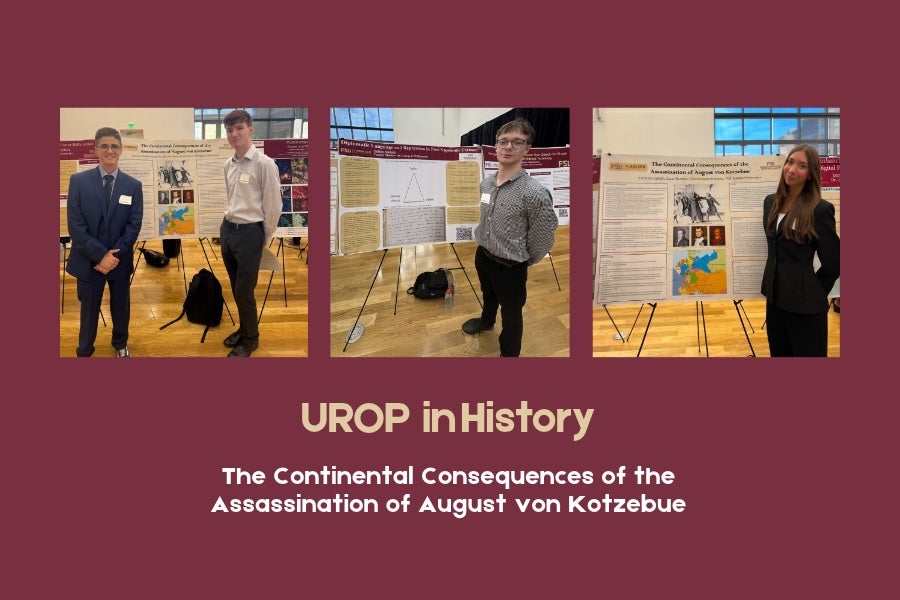
This project investigates political extremism in post-Napoleonic Germany. It focuses specifically on the years immediately before and after the assassination of the conservative playwright August von Kotzebue by the student nationalist Carl Ludwig Sand in March 1819. In 2024, Professor George Williamson visited the U.K. National Archives to consult the reports of British envoys stationed in various parts of German-speaking Europe between 1815 and 1820. Their reports were addressed to Robert Stewart, Viscount Castlereagh, who was the British Foreign Secretary at this time. They lent themselves to serving as the basis of a UROP project. The envoys’ reports, although handwritten, were quite legible, as they had been written by professional scribes. Their contents offered frank assessments of post-Napoleonic Europe and the mood of opposition that led to acts of political violence in the German lands and elsewhere.
Professor Williamson is a specialist in modern German cultural and intellectual history. His current book project is a study of the role of the playwright August von Kotzebue in German cultural and political life during the late 18th and early 19th centuries. Williamson mentored four students in this project. Victoria Pivatelli is a sophomore, majoring in political science and psychology. Oscar Gurdian, a freshman, is also a political science major with a strong interest in History. Harry (Charalampos) Archavlis is a senior graduating with a major in criminology and a minor in psychology. His interest in political violence and terrorism made this the perfect project for him. Nathan Sanborn is a junior majoring in History with a minor in education. Professor Williamson will be presenting a conference paper this summer which draws on the work done in this UROP project. All four students will be listed as co-authors on the paper.
How did you find out about UROP?
Victoria: My current roommate did it last year as a freshman. She is a biology major, and she did a project in her major. I thought it looked interesting, and I wanted to do it too just in my areas of interest. I have read a lot of case studies relevant to my majors, and I learned about research through these fields. I thought it would be extremely fascinating to do research as an undergrad. I applied to three UROP projects overall.
Why did you apply to this UROP project?
Nathan: I had only applied for two different projects, and this was my top choice. I am a big believer that history repeats itself, so learning more about terrorism, which plays an active role in society even to this day, interested me. I plan to become an educator, but I thought having some experience with archival material would be a great experience.
Victoria: I have been wanting to get more into history. I took a great class in my freshman year; it was about the American Civil War. But I also wanted to learn about history outside of the U.S. This topic appealed to me as it was about political control and repression in the 19th century. I thought I could learn more about history and also connect it to my major study.
Harry: I applied to a range of projects, but this one stood out to me. I wanted to find out more about events in Europe in the early 19th century. The topic of political terrorism and mass violence connected well with fields in my Criminology major.
Oscar: I was accepted into several UROP projects, mainly within my major. I chose this project for personal reasons; I wanted to learn more about domestic terrorism in Europe in the 1800s. As a political scientist I find the connection between mass violence and state responses very compelling.
What did you do specifically?
Harry: Our job was to transcribe, analyze and annotate, and sometimes translate, archival documents. The archival documents came from different areas of the German-speaking world and told different stories. The sources we focused on were from the period 1815-1820, during which you see the final defeat of Napoleon, stirrings of nationalist opposition in Germany, the assassination of Kotzebue, and the implementation of the Carlsbad Decrees. The Carlsbad decrees suppressed nationalist and liberal movements in Germany through press censorship, university surveillance, and the banning of student societies. Each one of us worked on a different envoy’s correspondence. Because I speak French, I worked on material written in that language. I focused on the descriptions of political violence. I worked on about 90 different documents.
Victoria: I worked mostly on documents concerning Prince Klemens von Metternich (1773-1859) who was both the chancellor and the foreign minister of the Austrian Empire. Looking through the British correspondence on him from the 1820s, I got to see how anxious and worried he was. He spent a lot of time warning the people who worked for him about a potential revolution. Altogether, I think I transcribed between 80 and 100 documents.
Nathan: I transcribed over 50 letters, most of which were either reporting movements of significant figures, or the happenings in different courts. I focused on the types of diplomatic language they used, and it was really interesting seeing the political intrigue that went on from 1808-1819, especially involving Klemens von Metternich.
Oscar: I transcribed correspondence sent by the British envoy to Saxony, John Philip Morier, to the British Foreign Secretary Castlereagh. In my annotations I focused specifically on identifying the people mentioned in the letters as well as identifying events that might be relevant. I got around 90 documents to transcribe.
Did you work together?
Oscar: We compiled our findings individually but then shared them as a group. In the beginning, Dr. Williamson gave us a set of lectures and readings so that we would have some context for the events we worked on.
Professor Williamson: In the spring semester, most of the meetings were focused on the posters for the research symposium.
Victoria: We met as a group every two weeks, both over Zoom and in person. While we did the UROP research on our own, the assignments from the UROP colloquium asked us to work together as a team.
I really liked my colloquium classes. My colloquium leaders were very interested in helping us, and they were passionate about their own projects. They often talked about how we can get more involved in research, in internships, or with RSOs on campus. That was very insightful and helped me think through my own plans for my time at FSU.
Harry: My UROP leaders were very helpful too. They communicated very well. They responded to my questions both in class and via email. They cared about each of their students.
Nathan: I was the only one who worked alone, I had a difficult schedule, working alone made things easier on me. I'm really happy with how everyone’s posters turned out.
My UROP leaders were very helpful, me and Harry were actually in the same class. I had such a good experience that I've already gone through the UROP mentor training and will be teaching a class in the fall!
What challenges did you encounter?
Victoria: Transcribing was a challenging task. I was lucky as my documents were quite clear and crisp. Others in my group had more issues with theirs. But I had some files that were in French, which was a more of a challenge as I do not speak French. They took me a bit longer to transcribe, but I eventually got the hang of it.
Once I had finished a document, I would put the transcript into a Google Doc. Then I added footnotes and comments about the people who were mentioned in the text, what they did, who they were, what they had accomplished. I sent Professor Williamson a summary of the things that I had learned from my files.
Researching the different people who were mentioned was also a bit of a challenge. There were some about whom I could find nothing in my online searches. That was when Dr. Williamson stepped in and said that he would take a look.
Harry: I found the handwriting challenging because it was old and in French.
Oscar: Yes, the handwriting definitely required a learning curve. There were certain ways people wrote letters back then that were confusing to me. For example, to write the letter ‘S’ twice together, people would write what looked like an ‘L’ and then an ‘S.’ And also the spelling of words was not yet uniform in the English language.
Harry: I had the same issue with the two Ss. I thought first that it was an F, before I realized what it meant.
Nathan: Like the others have said, the handwriting was challenging at first, but you get the hang of it. For some reason, one of the writers used = = at the end of each page, which had me confused at first! We had to also understand the positions of each writer and how bias may come into play, so understanding the context and who the writers were played a part.
What was the most surprising thing that you discovered?
Victoria: The most surprising thing was probably realizing all the consequences that flowed from this one event, the assassination of Kotzebue. How the after-effects of the assassination impacted the whole of the German Confederation and countries beyond. Furthermore, it was surprising to see how people latched onto this event, and ran with it, using it as an opportunity to pass more restrictive legislation.
Harry: One thing that I took away from this project is that history repeats itself. Just think, you have this dissident group of university students who were all nationalists and who assassinate the playwright August von Kotzebue, because of his conservative ideas. This assassination led to, on the one hand, repression exemplified by the Carlsbad Decrees. And on the other hand, Karl Sand, the assassin, was celebrated as a hero, and people tried to justify his actions. This divided reception happens continually. Even today.
Oscar: I have always considered myself to be quite knowledgeable in history, but I had no idea about these events. I was surprised by the weight this political assassination carried. His assassination was used by the powers of the day to instigate a broad crackdown on public opinion. For one individual’s death to have such an impact – that really surprised me.
Nathan: I agree with everyone's answers, l went through the same realizations. I think it was surprising to see that political or court intrigue wasn't something limited to novels or TV shows! In one of my letters, the writer discussed how Metternich was planning to write a memoir to simply please the Russian Emperor so he would not switch ideological sides.
How did you manage to combine your UROP work with your other commitments?
Victoria: Time management - that was the one thing that was particularly difficult for me, because I was taking five classes plus doing UROP on top. I also held a leadership role in my pre-law fraternity. This meant organizing four events each week, plus my coursework and transcribing the documents. I set aside an hour each day for work on the transcriptions. I handled things pretty well, but I wish I could have done more for the project, especially with regards to annotations.
Oscar: I sat down to my transcriptions whenever I had free time. Every day looked a little bit different. Sometimes, I could only manage 30 minutes before class, sometimes I did four-hour sprints.
Nathan: It was just whenever I had free time. My major has a lot of writing and reading already, so I had to space and plan blocks of time to avoid burning out. Thankfully I was very passionate about the project and the transcriptions, so it was not hard to be motivated during my down time.
Harry: I worked mainly on Fridays and at the weekends. Usually for an hour at a time. Finding enough time to do my UROP work was a bit of a challenge.
What advice would you give to students who are considering participating in UROP?
Nathan: My best advice would be to choose a project you are passionate about or interested in and to accept the challenges that come with the project. I cannot imagine ever working on a project that did not interest me. I would also say to take advantage of the UROP leaders, mine were always supportive.
Victoria: I think it is important to find a project that you truly connect with and that you really like. Because if not, it will be a hassle to have to work on it. But if you like the topic, and you are passionate about it, then you will want to work on it. You are motivated to do it.
Additionally, make sure you are organized and are able to manage your time. When you apply to UROP they will tell you that you should spend between five and ten hours each week on it. You need to be able to set those hours aside for the project.
Oscar: I would recommend it. It is a great experience. Research is important in a wide range of fields. I am in the humanities and pre-law, so most of the research I will be doing in the future will be law related. UROP teaches you how to communicate with professors and it teaches you professionalism. The colloquium did a good job teaching email etiquette and also presentation etiquette. It is a very solid professional foundation upon which to build later in life.
Harry: UROP is the best for experiencing research. It also looks good on your resume or CV. It shows that you have gone beyond expectations in college and that you have the desire to learn new things. It teaches you to use critical thinking to analyze evidence.
Do you want to continue with research?
Victoria: I am definitely going to look into other research opportunities in History or Political Science. I think it is very interesting and important for undergraduate students to get research experience.
Oscar: I am going to continue working on this project over the summer!
Nathan: I am going to be working on an Honors in Major thesis with Dr. Williamson that relates to the project! I was hesitant on whether research was for me before this project, but my curiosity has only grown.
Harry: I will be graduating by the end of the summer, and I am planning on going to graduate school and doing more research in the future.
Victoria: Hopefully, I will be in New York at NYU in law school in five years. I really like to study constitutional and international law. My sister lives in New York, and I have been interested in attending NYU law school for a long time.