
Senior Seminar Interview with Sam Kelso (FSU 2026)
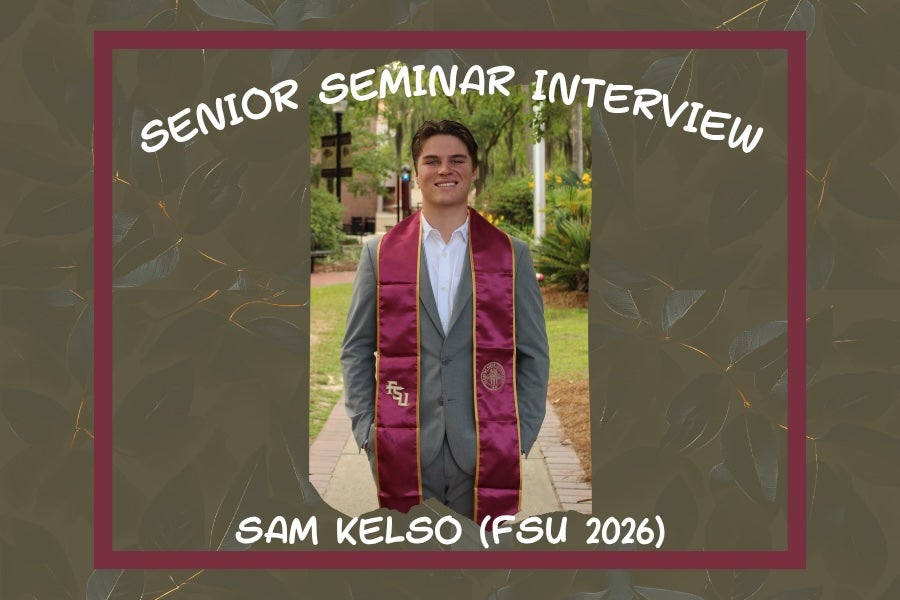
I double majored in sociology and History. I graduated this past spring. History has always gotten me excited. One of my uncles was a big history buff who had a huge collection of miniature soldiers. I spent hours in his basement looking at the battles he had set up. I also had a couple of very influential history teachers in school who pushed me to get involved and made the topic interesting. As I entered high school, I began to realize that I was more interested in writing, art, and history than any of the STEM subjects. History never felt like work to me.
I am from Knoxville, Tennessee, and FSU came on my radar screen when I researched universities with good film schools. In the end, I decided against doing film as a major, but FSU remained at the top of my list. The academic offerings aligned with my interests, and FSU was the most attractive school in the area. Coming here was a no-brainer.
What drew you to Dr. Herrera's senior seminar?
I had taken a class with him in Fall 2025. It was Latin American History Though Film – and it was phenomenal. Dr. Herrera was one of the best lecturers I had ever had. I learned a lot. I had talked to him about the senior seminar he was offering, and I knew I wanted to take it. It was also on Latin America and violence which piqued my interest even more.
What specific topic did you decide to work on for the senior seminar?
I ended up focusing on the history of Nicaragua during the Cold War. In the film class, we watched “Latino,” a film by Haskell Wexler, in which a Mexican American Vietnam veteran is sent to Nicaragua to aid the Contras in the fight against the Sandinista National Liberation Front, or FSLN. The accompanying lectures discussed the history of 20th-century Nicaragua briefly, and that was incredibly interesting, especially its interaction with America. I wanted to learn more, so when I had to decide what to research for the senior seminar, it seemed like a great way to keep going.
I researched the political ideology and the organization of the FSLN from the 1930s to 1979 when the movement overthrew the then-government of Nicaragua and seized power. I focused on how the movement tried to marry an internationalist Marxist-Leninist perspective with populist nationalism and revolutionary rhetoric aimed at drawing Nicaraguans to their cause. This combination was contradictory and difficult to maintain, and I investigated the impact of the American intervention on the conflict between the two ideologies. Through employing the Contras for low-intensity, slow but consistent violence, the U.S. was able to crumble away the foundations of the FSLN revolution.
The question I asked was: how did American involvement exacerbate the internal issues between the FSLN’s Marxist-Leninist and nationalist beliefs? The main period I looked at was from 1979 to 1990, the moment the FSLN seized power to the moment they lost it in an election. But I also laid out the background of the movement from the early 20th century onward.
What sources did you look at for that project?
I read a lot of memoirs for background information. Then for primary sources, I used speeches and essays by FSLN leaders as well as government publications. I focused specifically on how the content of those communications changed over time. I also drew on American government publications, and again I wanted to see how the texts changed over time. My paper thus took a double approach, primary sources generated by both the Nicaraguan and the American side.
Part of the remit for the class was that we had to add a new perspective or insight to the topic we were working on. Not just weighing up interpretations of other people. You had to ask yourself, what is the new angle and what are you trying to contribute? We were expected to push boundaries and had to be creative to be original. In this seminar class, we were treated more like a professional than a student.
All my sources were either in English or had been translated into English. I did not have any language issues. I tried to use as many physical books as possible and relied on online sources only when there was no printed alternative. When I was done with the project and getting ready to leave town, I took a big bag of books over to the library and dropped them all in the book bin. That was an amazing feeling.
What was the most challenging aspect of the senior seminar?
This was the longest paper I have ever written. There were two things that were difficult to do. In many ways, getting started was hard. I knew the direction I wanted to go, and I knew the questions I wanted to ask. Through that, I started going through my sources and let them reveal their particular points of view. That allowed me to see where I needed to do more research and also how to narrow the scope of my paper. We had an upper page limit for our paper, and it was not easy to wrangle my material, so I stayed below that. I could have added another ten pages to my paper, easily. Cutting things and condensing my writing was the second difficult thing to do.
How did you handle time management? What was your trick?
It was actually quite tough. The semester was not easy, as I work at a restaurant, and I was taking three classes in addition to the senior seminar. I made it, I graduated, and I got the grades I wanted. But it took a lot of discipline, a lot of working when you did not have much energy left, and a lot of saying no to social things. I was still able to have a good time, but it did require me to prioritize the senior seminar paper.
I tried to work as consistently as possible. On the days that I had time, I sat down for at least a couple of hours to work on the paper. I also got the coursework for my other classes done early week, so that I could focus on the senior seminar over the weekend.
What was the most surprising thing that came out of the senior seminar?
For me the biggest surprise was how class-led the senior seminar was. While Dr. Herrera was always there to guide discussion and provide feedback and support, his senior seminar was a very student-led class. For the first eight weeks, we read four books together as a course, each book stretching across two weeks. And two students would be in charge of leading the discussion each week. The books took us through different ways in which people had done research in Latin American history. I had not expected to lead the class myself, so that was a big shift in how one normally participates in classes. It also meant that I got to know my cohort very well, we all read the books together and talked about them together. The whole process was very collaborative. We were all expected to read each other’s papers, and then each one of us got to provide in-depth feedback to one student. As everybody was familiar with each paper, we spent two class periods discussing each essay, asking questions, adding material. Dr. Herrera also provided his insights. Working so closely together as a group was a positive experience.
What advice would you give to a History major about the senior seminar?
I was fortunate because I knew the professor I wanted for my senior seminar, and I somewhat knew what to expect of the course. So, my advice is: do your research on the professors offering senior seminar courses and get familiar with both them and the content of their specific seminar section. If possible, take the time to meet them before the course begins. This class is a significant commitment and is incredibly immersive. It requires intensive research and constant collaboration with both the professor and your peers. I would certainly have had a much different experience had I not selected a course that I found interesting and been fortunate enough to have a professor whom I both respect and enjoy. If you are excited about your topic, know what to expect from the class, and have allotted a semester to commit a few strong hours per week to seminar, it will not always feel like work.
Additionally, be prepared for the workload that comes with a senior seminar. Try to take it during a semester when you have the time for it. You need to have time throughout the entire semester, so that you can stay on top of the workload, and it does not feel overwhelming to you. Consistency is the key.
Would you do anything differently, if you could go back in time?
Honestly, I would have tried to take the senior seminar before my final semester. I did have to say ‘no’ to a lot of things because of the class. If you have the option, aim to have a little bit less intensive coursework in your last semester in undergrad.
The other thing that I would do differently is to start my research earlier. I knew what I wanted to do, and I had looked through a lot of my sources, but I did not dive into them completely until about two thirds through the course. If you don’t know precisely what you want to do, it is important to start your research early on in the semester. It would have helped me in the long run and made things easier. The more you know about your subject early on, the more opportunities you have to refine your topic and the approach you take.
What is coming next for you?
I have plans to go to law school. I am taking a gap year and then sending in my applications for the next cycle of law school.