
History-Intensive Semester in London PLUS Senior Seminar: An Interview with Harper West (FSU 2027)
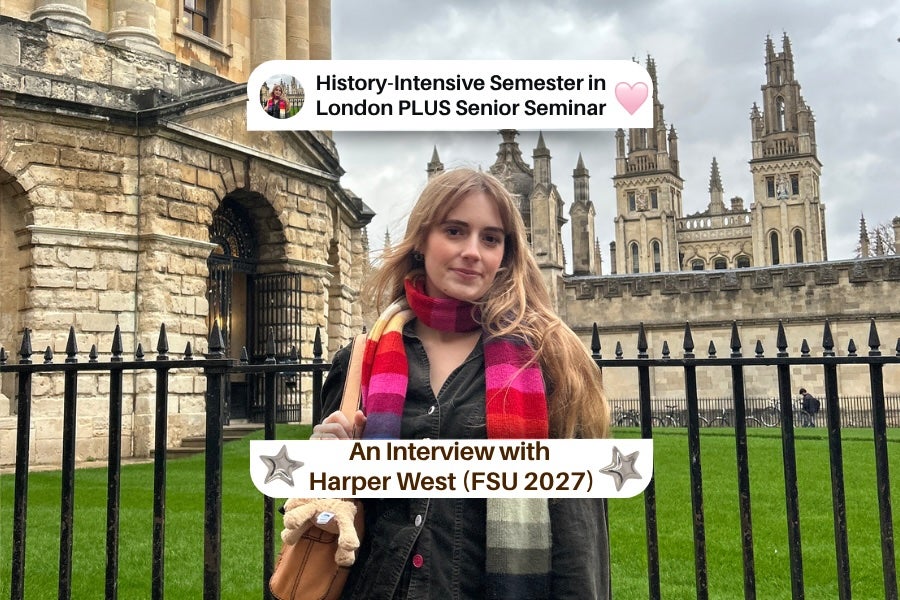
I came to college knowing that I was going to be a History major. I had a great History teacher in high school. He took history beyond learning dates and time periods and connected it to other subjects. I am doing a dual degree and added environment and society as my second major. History has helped me develop critical thinking skills and understanding how important it is to know the history of something. It was a great starting point for me in college.
While I had initially wanted to go out of state for undergrad, that did not pan out, and of the two schools I toured in Florida, UF and FSU, FSU had the more welcoming campus. I felt immediately that I could see myself as a student there. I got admitted to the Honors College and was then selected for the Presidential Scholars Program which offered me a full scholarship and more. The decision to come to FSU was easy — although I had already decided during the interview process that I was going to FSU no matter what.
I am interested in the lives of everyday people, micro history. I am curious to know what it was like to be just an ordinary person in this city, in this country, at this specific time. I have focused on more modern history, and I have also taken classes with Dr. Doel on the history of environmental policy and science. It was neat to bring my two interests together. The title of my senior seminar paper is “Poor Law and Sanitary Practices in Victorian England: A Comparative Analysis of Local Governments and the Needs of the Poor.”
How did you combine studying abroad with the senior seminar?
I studied abroad in London in Fall 2025. When I came to college, I thought “I am never going to study abroad. That sounds so scary. A semester will be too long.” I had never been out of the country before. But then everybody I knew was studying abroad, and that made me think of trying it too. First, I thought, “I’ll do it, but just for a summer.” However, I did not find the classes I needed for my two majors. I wanted the courses I took abroad to count. Then I found out about the History-Intensive Semester in London, and I knew that I wanted to do that. I am so grateful to the enrichment funding I received from the Presidential Scholars Program, which made it possible for me.
Professor Upchurch had talked to the History majors about starting a history project in London and then continuing it in Spring 2026 in his senior seminar on 19th-century British history. I liked that idea as European history had been a bit harder for me to grasp before. Being there in person to experience it directly rather than only hearing about it in the classroom was very helpful. I took two of Dr. Upchurch’s classes in London: “England since 1870,” and “England, Empire, and Commonwealth.” I also took a class on Tudor history and one on women’s literature. It all came together nicely.
Classes were arranged as blocks; I had the same class once a week for three hours. We started the first hour with a lecture, and then the rest of the class we visited historical sites or museums connected to the lecture. Learning became more hands-on; we explored the city and also understood how to navigate public transport. This made learning so much more impactful.
What topic did you research while you were in London?
Initially, I had wanted to focus on social issues and had thought about working on the Green Movement in the 1970s. And then something changed when I got to London, and I thought, “There are so many more things popping up around me to research. I need to be open to issues that really grab me.” One day, I had been at a restaurant with my friends, and in front of it there was a water pump with historical plaque that referenced the Soho Cholera Epidemic, stating that it was this pump that led to the discovery of cholera as a water-borne disease. I thought that was very interesting, and the subject tied to other topics I was passionate about, like environmental concerns and social justice. Professor Upchurch and I put together a list of books that I then read in the British Library. Two of those were at the heart of my senior seminar paper. I decided to stay in the Victorian era with my research and got some more documents from the UK National Archives.
What was it like working in libraries and archives in London?
We went together as a class to both the British Library and the U.K. National Archives and got our readers’ tickets. That gave me the confidence to go back on my own. It felt almost surreal, because you are sitting next to someone at the reading tables who is working on their third book and here I am, an undergraduate doing research. Once I sat down with my materials, I began to feel like everyone else in the room, it is a respectful environment. You need to be quiet and careful with your documents. The security guard asked me if I was a Ph.D. student, and I said, "No, just an undergrad at an American university."
Sometimes it was very tempting to go explore London rather than do my work. But then I reminded myself, I am studying in the British Library, this amazing space full of books. Homework will not be boring because I can do it in a beautiful place or a really cute café.
Would you have been able to do your project without having been to London?
I could have, but things would have been different. There were materials I could not have accessed remotely. I am not sure that I would have even thought about doing this topic had I not been there. Seeing the hand pump at the center of the 1854 cholera outbreak in person inspired me. While you are in London, you can go to so many different museums that even if you do not know what to work on in your senior seminar, you will most certainly find something that inspires you to research further.
Did your topic change when you started the senior seminar?
I came back and thought that I had all my sources together. But that was not correct. In the National Archives I found letters from the government, from the Poor Law Union Boards. I had thought that these letters would be from the perspective of the poor, but they were not. Then Dr. Upchurch and I discovered this great secondary source, a book called In "Their Own Write: Contesting the New Poor Law 1834-1900." And it was a collection of letters from the poor during the Victorian era from the National Archives. I used that book to show the perspective of the poor, and the letters from the Poor Law Union Boards to provide the perspective of the government.
I looked specifically at sanitation issues. That included talking about epidemics like typhoid fever, cholera, and so on. But at the heart were sanitary issues, showing which ones the government was focusing on, and which ones the poor demanded. The poor did not want to be in workhouses; they wanted to have poor relief provided to them outside those institutions. But the Poor Law Union Boards were only talking about workhouses, they documented what happened there, their concern was to get more people into the workhouses, not to provide relief for them outside. Their focus was on issues that affected the entire population not just what affected the poor.
Having done some research in London made me feel less nervous about taking the senior seminar. It also made me feel more connected to the topic. Going through my documents from the archives reminded me of my time in London, made me feel nostalgic – but also gave me solid context for my work. Analyzing my sources in the senior seminar showed me how to connect my secondary sources to my primary ones. Since I could not go back to get more material, I needed to use what I had collected in the most effective way.
How did you handle writing your paper?
I found the research and analysis of my documents challenging. Once I got to writing, I was excited because I saw how I could tell a story based on my research, how I could knit all these seemingly unconnected sources together. I have been a History major for a little while, which meant that I had some experience with writing essays. Writing was not necessarily easy, but I was looking forward to it because I wanted to put all the ideas together. We got line-by-line handwritten edits from Professor Upchurch on our draft essay, which were really helpful. The senior seminar strengthened my writing skills.
How helpful was doing the in-class presentation?
It allowed me to tell my peers the most important aspects of my paper in 15 minutes. I was able to tell them what it was like to work in the U.K. National Archives and the British Library. Quite a few classmates were interested in that side of my research. It made me feel proud of what I had done. The presentation was a great way to end the semester and to end this chapter of research.
How important was the History-Intensive Semester in London to you as a History major?
I think it is absolutely something that History majors should do when they have a chance. I have a friend, also a History major, who studied abroad with me, and we both agree that we would not have done that without the History-Intensive Semester being offered. Studying abroad is expensive, and while you can always take classes you are interested in, you should be taking classes that count towards your degree. With the History-Intensive Semester, we had Professor Upchurch come over from Tallahassee to offer two History classes on aspects of British history and teach them in the place where many of the events we learned about happened. You can focus on the place you came to study in.
We had a lot of non-History majors in the classes too, especially First-Year-Abroad students. For them it is a great introduction to History and having it with a professor from the main campus gives them a taste of classes to come. Students in my other classes were jealous of how many excursions we had done, how many museums we had visited. Yes, the History-Intensive Semester sharpened my research skills and allowed me to learn history in an immersive way. It allowed me to have the whole study abroad experience, which I am grateful for; I would not have gone if that semester had not been offered.
Everybody tells you that studying abroad changes your life. And before going I thought that sounded so dramatic. But it is true. It changes your perspective on the world. If you have a chance to travel, take it. FSU International Programs made it a very easy experience. You stay within the FSU framework; you continue to use Canvas or MyFSU. You do not have to advocate for yourself in a foreign country. And if your professor is coming over from Tallahassee, they really understand your excitement and anxieties. I did it in the first semester of my junior year, which was a good time to refresh my college experience. I am very grateful to FSU for making all of it possible.