
Studying Abroad: History-Intensive Semester in London with FSU Students Nathaniel and Andy
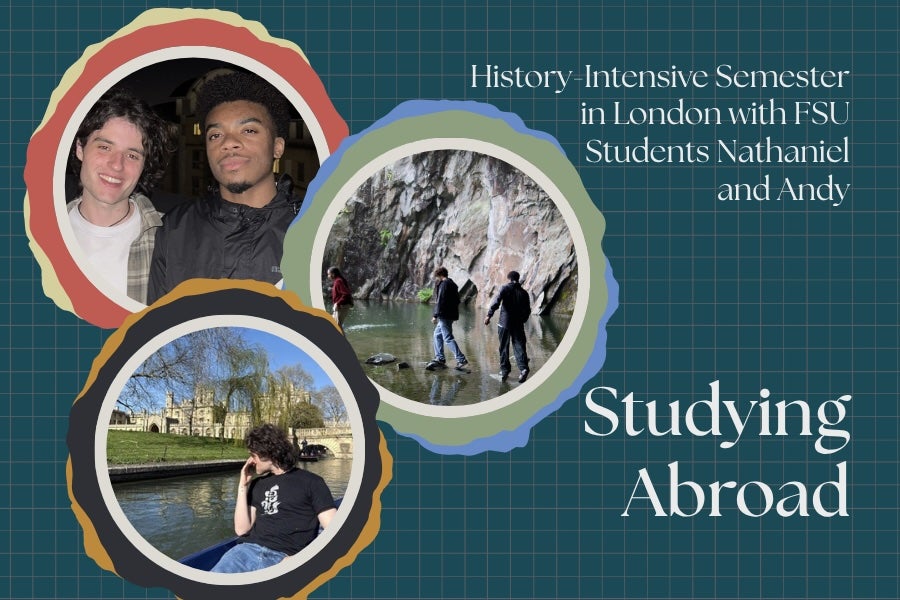
In Fall 2025, Professor Charles Upchurch offered FSU students the opportunity to do a History-Intensive semester at FSU’s London Study Center. While many History majors enrolled for the semester, the history courses were also open to other students at the study center. In this interview, we hear from Nathaniel, who did FSU’s First-Year Abroad program, and wants to study neuroscience, and Andy, a transfer student and History major.
Nathaniel: I was born in England and moved to the U.S. in 2012. My ethnic background is slightly mixed making me both English and Jamaican by both parents to varying degrees. There is a lot of colonial history in my family that made me want to learn more about England, the colonizing power.
I came to FSU because it was the best school to offer an undergraduate neuroscience studies program. I aim to become a neurologist or neurosurgeon. Being able to call helping people part of my daily job is important to me.
I chose to do the First-Year Abroad program in London because the course offerings tied in best with what I needed to fulfill my core requirements. I also wanted to be in a very big city, to make connections and meet new people. London is a mega city. I think it is a good place to have a foothold for my future.
Andy: I am a transfer student. My previous institution was large and impersonal: I was a History major there, as I am at FSU, but the sheer size of my previous university proved to be extremely isolating. I had largely online courses. In many ways, I felt that, even though I had left home for another city, I did not get the traditional “college experience.” No campus community, no small classes, no personal connections.
A friend of mine in FSU Film convinced me to transfer. It wasn’t something I had even considered; I had felt like I was at a dead end. But I applied, and, almost miraculously, got in after a deferral.
When I came to Tallahassee for orientation, I saw a poster outside of my advisor’s office about a History-Intensive semester in London. It promised everything I felt I had been missing: small class sizes, community, and the opportunity to experience a foreign city (I had already thought about living in London). In that moment, I decided that I wanted to spend my first semester abroad.
My issue was that the deadline to apply for fall had passed before I had gotten into FSU. So, I took the initiative and went to the International Programs office to see if there was any space. There was. From the beginning, I had an unconventional way of getting to FSU London. That unconventional method made me a lot more motivated and hungrier to learn.
The fact that the semester was History-intensive was amazing. Dr. Upchurch’s classes were fantastic. I had mentally stimulating coursework. I made a lot of friends abroad. The semester allowed me to make connections with professors, which is very valuable. It was everything I had lacked in my first year of university.
Studying abroad changed the trajectory of my life and set a perfect transition between my previous institution and FSU. It has also made my life goals feel much more plausible. My career goal is to be a novelist of high fantasy and create a franchise like Game of Thrones, Star Wars, or One Piece. Eight books, eight movies, and a thriving community around the franchise. Studying abroad was a major step in building the confidence I needed to compensate for my ambition.
What History classes did you take in London?
Nathaniel: I took the “History of England since 1870” class that Dr. Charles Upchurch offered in Fall 2025. I learned how England generally became what it is today, but the biggest thing I took away is learning how to do archival research. We started every class meeting in the Study Center but then finished our lessons with excursions to historical sites in London. Every single class, Dr. Upchurch took us somewhere different. We went to the Docklands Museum, to Canary Wharf, to the Tate Modern.
Andy: As a History major, I took two classes with Dr. Upchurch in London: “History of England since 1870” and “England, Empire, and Commonwealth.” Even between the two courses, Dr. Upchurch never repeated an excursion. Because of this diversity, I saw parts of the city I hadn’t even considered simply by coming to class. Dr. Upchurch took us to the sites relating to whatever he had just lectured on that day, so material really stuck.
It also meant that as we went through the decades in class—particularly in “England since 1870,” the places we visited became more and more modern. For the last class, we went to the new City Hall of London to see how far the city had come over the years. These excursions were my favorite part of the academic aspect of studying abroad. Though all my professors took us on excursions, Dr. Upchurch was the only professor who took us somewhere every time we met.
One of my biggest historical interests is empire and how it is justified. Between information from both of Dr. Upchurch’s classes and archives, I wrote a paper examining the lives and careers of eleven eighteenth-century siblings—the Johnstones—who engaged with multifaceted aspects of empire during their lives. The East India Company, a Member of Parliament, the first Governor of West Florida, a Jacobite, slave holders, abolitionists: it felt as if the family served as a microcosm for the Empire as a whole.
Particularly, I focused on George Johnstone, the West Florida governor who also served as a commodore in the Royal Navy. His brand of masculinity (the family correspondence gossips about his recklessness and tendency to duel) intrigued me; he seemed like a character who would seek to justify the Empire in all its facets. I wanted to understand what creates that kind of character, for they are the ones who create and uphold Imperial systems. I believe that it is crucial to understand and identify these patterns so as to pick them up in the modern day.
Beyond the family correspondence and secondary sources, I went to the archives in the National Maritime Museum to study letters from George—mainly direct orders he gave as a commodore—and papers from contemporaries critiquing his reckless actions. It was incredible to handle the written word of a man I spent so much of my time studying and drawing conclusions from it, and that is not an experience I would have even considered if I had stayed at my previous institution and had not been involved in Dr. Upchurch’s History Intensive.
How did the class assignment tie into your excursions?
Nathaniel: On one of our excursions, we went to the U.K. National Archives in Kew. We had to write a research paper for the History of England class. The National Archives was a place where everyone in the class could get some evidence or reference for the different topics we were working on. I researched decolonization in Jamaica. I was able to find a myriad of sources regarding that topic. I even found my great-grandfather’s immigration records! He was part of the Windrush generation.
I looked at records on education and economics. I reviewed newspapers, and I also requested some military records. Working in the National Archives was a surreal experience. I kept thinking – I, as a first-year undergrad, shouldn’t have access to these documents. It felt weird, holding files that had so far been only seen by experts.
Andy: I also felt that it was surreal. I am not a freshman, but even as an undergrad in general, it was surreal. I was essentially sitting in the National Archives with a Cambridge professor on my left and an Oxford professor on my right. When you do this kind of research in this city, you do it surrounded by people at the top of the field, the world’s greatest professionals. That was very strange, but it was amazing. It felt formative in a way, like I was getting ahead.
Nathaniel: We also went to the British Library as that was much closer than the National Archives. I found some material there too for my paper. There was a book by Anne Spry Rush, Bonds of Empire: West Indians and Britishness from Victoria to Decolonization, that showcased the experience of people around the time that Jamaica gained its independence. That was a good source for my paper.
Andy: At the end of the semester, Dr. Upchurch took us to Sky Garden. That was bittersweet. We were sitting there, looking over the city that we had spent so much time in, talking about our projects. It was a very nice way to wrap up the class.
Was sitting down to write your papers a challenge, given the exciting opportunities of the big city?
Nathaniel: I would say sometimes it could be a bit difficult because there really is just so much to do. Sitting down to write my paper was not always the first thing on my mind. But because it was a subject that I enjoyed, got to choose for myself, and had a vested interest in, it made it much easier for me to find the time to write and put effort toward creating a good piece of work for my class.
Andy: I would argue that because of the fact that I was in London and was surrounded by so many professionals and archives, I felt more motivated to write than I often do back here in Tallahassee. I was surrounded by all these things that were relevant to what I was writing. That isn’t to say I’m not motivated to write in Tallahassee, but London was just so very immersive.
Which of the Study Center excursions did you enjoy the most?
Nathaniel: This semester, going to Cornwall was cool for me because of the food. Do you know what a Jamaican patty is? They come from Cornish pasties. I had been curious about going there just to see the difference. Last semester, visiting Ambleside was a nice excursion. It is a historic town in the Lake District on Lake Windemere.
Andy: I think Ambleside was also where students started to get close. One of the biggest things about studying abroad is the bonds you make. The Study Center excursions helped a lot with that. Friendships started to form on the trip to Ambleside, but they really solidified when we went to Wales. We went surfing and coasteering in Wales. And we did archery.
Nathaniel and Andy: Surfing and coasteering were favorite memories from the fall.
Was it difficult to make friends?
Nathaniel: I met Andy in the student lounge on the first day when we were all waiting for the orientation meeting. We just started talking. Connecting was very easy as everyone was new. I also think that those students who choose to study abroad for their first year are more open to meeting people and having new experiences. It was not a struggle to find friends.
Andy: Agreed. You are all in the same boat, you came to a different country and don’t know anyone. The first instinct is to connect with people. These friendships get close very fast. Through Nathaniel I met the rest of his flat mates and we all became friends. On the excursions, we connected with even more people. By the end of the semester, everybody knew everybody else. I have no doubt that the friends I made abroad will stay with for the rest of my life, and it also gave me a built in circle when I got to the main campus.
How easy was it to connect to people outside of the Study Center?
Nathaniel: We were lucky as we had another friend who attended University College London. Through him we met a lot of students from outside the Study Center.
Andy: We were very lucky to have a circle of friends within UCL. I went back to London for spring break, and I made more friends from outside of the program. My goal was to connect with as many people as possible as I am thinking of living in England after undergrad.
How different is doing History in London versus doing history in Tallahassee?
Andy: It can be a lot more difficult in Tallahassee because you are not surrounded by so many different kinds of history. The big thing that the main campus in Tallahassee has on FSU London is resources within the university. There is also a much wider range of courses, You can take a class on seemingly anything. But on the other hand, you cannot go into so many different museums and archives to read documents firsthand. There are pros and cons. For me it was important to have the experience of London because I am now approaching my classes with a different perspective and a different way of doing things.
What surprised you about living abroad?
Andy: There are a lot of differences in ways of doing things. Being exposed to another culture was very interesting. The ability to go anywhere in a major city was amazing. There is so much going on all the time, from film premieres to really big city parks. And with the Study Center you are at the heart of it, right next to the British Museum. It is actually an incomprehensible opportunity. London is also a launchpad for travel; I flew to different countries in Europe — Germany, Spain, and the Netherlands — and it was not that expensive. Being abroad is like knocking off cobwebs and unlocking parts of your brain that you didn't realize existed, because now the ability to travel in that voracious way feels attainable.
The most important thing is that it allows you to get another perspective on life. It lets you come out of your bubble, branch out, and meet different people. In London specifically, you meet people from around the world; it is a very cosmopolitan place. That is eye-opening, and, I think, necessary. So many of us live in communities surrounded by people who are, culturally, exactly like us. When nobody leaves that, we begin to see friction between groups for the simple lack of communication and understanding. I want to go places and understand as many people and things as my brain can comprehend for the rest of my life.
Nathaniel: Andy made a lot of good points. Let me go further. When it comes to culture, I think that the cultures of the U.K. and U.S. are more different than you would expect. Especially given the connection between the two countries. A lot of my fellow students were not particularly politically aware at the start of the semester. But over the year, in London, you are automatically exposed to marches and demonstrations, and you hear a lot about politics and controversies on the news. You also get news on the U.S. from a different perspective; it helps reduce the bias when you have access to different news sources.
We have also all become more aware of our money due to the changes in the exchange rate. You can see how the economies of the two countries work; it makes you a little more worldly. I agree with Andy about traveling. London is a great launchpad for traveling in Europe and that can open your eyes to travel and new experiences. In London, you are also very likely to run into people from school back home, and you see that the world is a lot more connected than you think.