
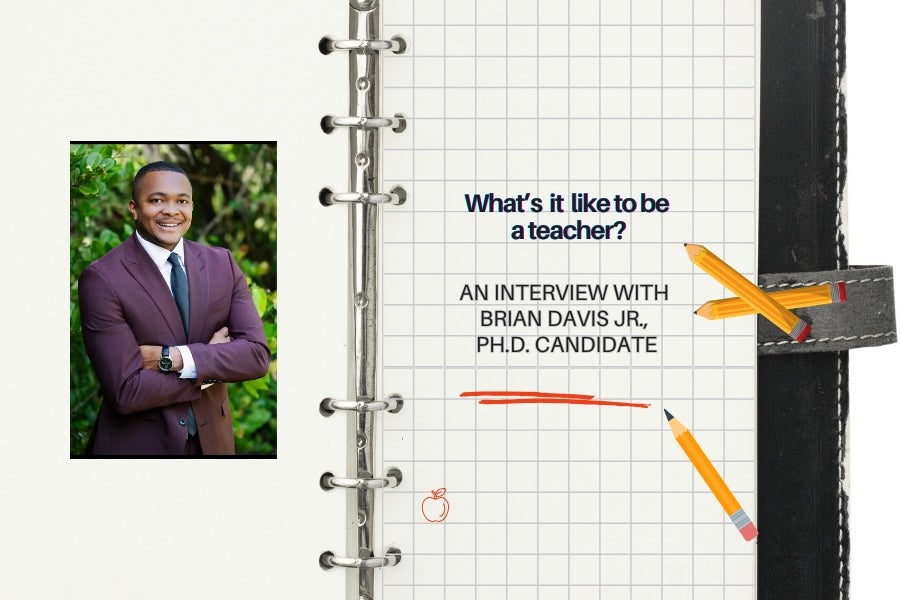
What’s it Like to Be a Teacher? An Interview with Brian Davis Jr., Ph.D. candidate
I got interested in history through my uncle Howard. He was a Vietnam veteran. He had his own archive in the basement. He had kept all his letters, a lot of his photos, and other memorabilia. He used to talk to me about his war experiences and those of his friends. That’s what always intrigued me. It was my first introduction to history outside of school.
In high school, history was the one class I always looked forward to, I had a passion for. But it felt as if there was a lot missing from the story that we were told, mainly because of what my uncle Howard had told me. I went to Winston-Salem State University, an HBCU, and that’s where the history world really opened up to me. I had some fantastic professors who introduced me to a lot of different histories. Once I finished my History degree, my professors pushed me and said, follow your passion, don’t just give up on history. I was a first-generation college student and knew nothing about grad school. They sat me down and talked me through the process. I came to Florida State to do an M.A. in history and stayed on to do the Ph.D. I am a military historian with a concentration in African American culture and history.
How does it feel to teach?
It's fantastic. I really enjoy it. I feel like I'm in my element when I'm in front of a classroom. I have a lot of energy. I'm very humorous. I like to joke a little bit here and there. I challenge my students to think differently about historical developments, about people. We look at grassroots activities a lot. I want to bring the lived experience to the students to help personalize history for them. Right now, I am teaching AMH 2020, American History Since 1870. I have taught it both in person and online. A lot of things that we talk about in American history courses, the students might have a relative who has experienced that, or they may trace their family history back to a particular immigrant community. To make history come alive we look at letters and photographs, so they can kind of visually see what was going on and how people were feeling about the historical developments we discuss.
Do you teach differently when you do online versus in person?
Absolutely. With my in-person class, I can be interactive. We can have a dialogue. When I'm in front of the classroom, I will ask questions, check in that the students are following along, or challenge them to interpret a primary source to keep them engaged and on their feet. Sometimes I bring in historical artifacts, photographs or similar things. A lot of my students will never go to an archive, so when I bring in an object or a document, I can let them touch and feel a piece of history. This can provide a different perspective.
You lose that kind of dynamic in online teaching. I give my students a whole week to go through each set of lectures and readings that I post online. The students have the freedom to pace the work according to their own schedule. I only post one week’s worth of material at a time, so that the students don’t move too far ahead. This way, they can get feedback on their assignments and can resubmit their work. It allows them to grow in their writing throughout the semester.
While students enjoy the freedom to move ahead at their own pace, online teaching does take away from their experience as a student – and also from mine as a teacher. I tell my students in the first week of class to see me not just as an instructor but also as a mentor. I explain that I have had a whole range of experiences as a student, and that I can help them, regardless of what major they are in. What you learn in history classes is applicable to all other fields. If they are having trouble writing, I invite them to my office hours, and we break down the challenges. I share with them things that helped me as an undergrad. In online classes you don’t have that immediacy.
What is your goal as a teacher?
My goal as a teacher is to encourage students to be more critical about history, to think differently about history. History can be interpreted in a number of different ways; that’s what history writing shows us. That's something I introduce into my classroom. I explain how scholars might have different experiences and perspectives or might look at different sources, so their findings feed into an ongoing conversation about history.
Additionally, I want the students to understand that current events have historical roots, that things do not just pop up out of nowhere. There are historical developments that are continuously playing out and reshaping and reforming themselves as society grows and changes. Students enjoy seeing events in a long-term framework. When I cover the Black freedom struggle, for example, I don't teach it just in the 1960s. We start in the early 20th century and trace developments all the way to the 1970s. The students can then see historical developments as a continuous conversation. In the student surveys, the students write, “You told me stuff I did not know. I thought these events were only happening in the 1960s.”
How do you know a class was a success?
A class is a success when the students say that they learned something. It doesn't have to be anything major. It could be about a specific individual or a policy. And when they say, “Hey, history is not as boring as I thought it was,” that’s when I know I have done my job. Because history is not boring. Yes, it can be very dark and can cover negative things, but there are also a lot of bright spots. We can't talk about the bright spots without talking about the dark times as well.
What have you learned from your students?
I have learned a lot. I have participated in FSU’s Center for Academic Retention and Enhancement program for two summers with Dr. Maxine Jones. That taught me that flexibility and communication are the key. I am aware that my own undergrad experience is no longer representative. I am flexible on assignments and due dates without lowering my standard for academic excellence in the classroom or lowering my expectations I will tell a student: you can do better than this, and I am going to help you reach the goal.
Being flexible though is crucial. Life happens. There are a lot of different things that go on in our students’ lives, and while they want to succeed, life might get in the way. Learning is also not just about the grade. Yes, grades are important, but they don’t always showcase what you have learned in a course.
I learned to listen to the students. I run a midterm survey asking the class for feedback on things so far. And that is a helpful check to see where we have communication problems. The first time I taught, I told the class the day after the survey: “Hey, I really appreciate your responses. And this is how we are going to change things.” At the end of the semester, the students explained: “We appreciate that you listened to us. A lot of instructors teach, but they don’t listen to us.” My students taught me to be flexible and have an ongoing conversation with them.
What has teaching taught you about yourself?
What has it taught me about myself? I think it has really supported what I already kind of knew, that I truly love history. It's the only subject that I have a true passion for. And it's something that I could spend the rest of my life doing and be happy. I have worked a lot of different jobs, for the federal government at the ABC store in North Carolina, for FedEx, UPS, Walmart. I was never truly happy doing those things. I am happy with teaching.
I also enjoy producing new scholarship. When I'm grappling with some of my own historical questions, those I will also talk about in the classroom. When I talk about Black military experiences and the development of the military, that’s something I am also wrestling with in my scholarly work. I have a theme of military history throughout my course. I spent time on the Korean War. And also, on the Vietnam War because a lot of military developments mirror or drastically impact how we see our country and how our country has grown over the years. I look at military history from a social and cultural perspective; what were people doing and how were they reacting to policies.
Was there a particular undergrad teacher who inspired you – how and why?
There were three professors in undergrad who influenced me the most. They pushed me to continue with academia. And they gave me the guidance I needed to apply to grad school. They were Dr. V, Dr. Siddiqui, and Dr. Gaitors during my time at Winston-Salem State University. Dr. Siddiqui who was from the Africana Studies Department provided me with different perspectives on how to analyze and understand Black history and culture. That really transformed how I was viewing the material that I was working with at the time. I did my senior thesis on Black power organizations that Black soldiers created while they were in the military. My undergrad professors had a long-lasting impact on how I see the world, how I interpret documents, how I work with history, and how I teach.
Here at FSU, it’s Dr. Maxine Jones who has been my mainstay. I tell her all the time how much I truly appreciate everything that she does. When I first got into the department, I was highly unsure if I belonged at FSU in the graduate program. Dr. Jones reminded me, “You're here for a reason. You're here because you belong here.” I know that no matter how many years have passed, I will always have Dr. Jones in my corner along with my other mentors.