
UROP in History: In the Footsteps of Bandits - An Alternative History of Spain
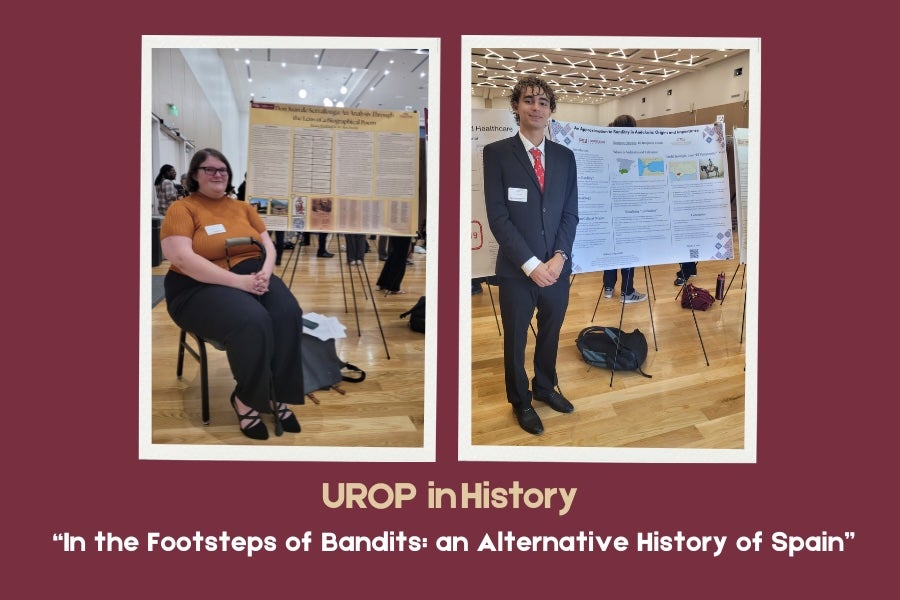
Dr. Ben Dodds, associate professor of History, directed a UROP project on the history of Spain told through the lives of bandits. The project uses the stories about real and imagined bandits from the Roman period until the present to explain the history of Spain. For example, the Roman conquest of Spain is explored through the story of non-Roman bandits who resisted the conquest. Likewise, the consolidation of General Franco's dictatorship is explored using popular and politicized versions of stories about bandits. These bandit stories are windows on particular political developments.
The project supports Dr. Dodds’ current work on an academic monograph on the history of Spain through the lens of bandits. It will also provide material for a website dedicated to Spanish bandits which Dr. Dodds is planning on setting up. This is the second time that Dr. Dodds has offered this UROP project.
Dr. Dodds mentored two undergraduate students: Moira and Santiago. Santiago is a Political Science and History double major. Santiago was born and raised in Spain before moving to Miami. He is bilingual in Spanish and English. Moira, a rising senior, is an Art History major. Tallahassee is her hometown.
What kinds of history do you like?
Santiago: Being from Spain, I love learning about Spanish history. My family is very much into history as well, the Spanish side of my family especially. I grew up around authors and artists who all loved history. My goal is to become a professor or teacher.
Moira: I am passionate about art history. I knew I wanted to work on Islamic art, but was not sure about which area to specialize in. This UROP project has helped me decide on Islamic art in Spain. I also have a long line of family members who are fascinated by history.
What is your UROP project about?
Santiago: I studied banditry in the region of Andalucia, which is the southernmost region of Spain. I looked at the economic, social and cultural causes of banditry in that region, around the late 18th, early 19th century. Andalucia at that time was divided into huge estates, latifundia, owned by very wealthy people and a peasant class that owned no land. Most of the population lived in towns and cities which meant there were large areas which were very sparsely populated. Bandits were easily able to attack people traveling from town to town. Most of the bandits worked in gangs. They were organized under a leader who often had a lot of experience.
I studied a bandit by the name of Jose Maria El Tempranillo. He was called El Tempranillo, which means early, as he started his bandit career when he was very young. Once a bandit became famous, others flocked to them, and they could build their gangs.
Moira: I studied a biographical poem about one specific bandit, Juan de Serrallonga, in Catalonia who lived in the late 16th, early 17th century. The poem itself was published in the mid-19th century in Spanish instead of Catalan. And I compared it against his real life, considering that biographical poems are not always historically accurate. I also compared the poem against other literary works such as Don Quixote and Tirant lo Blanch to see what comparisons I could make within the romantic, chivalric literature genre.
What sort of sources did you use to research your respective bandits?
Santiago: It was a mixed bag of sources. There were some articles written in English about El Tempranillo’s gang, and there were novels written in Spanish in the early 1800s that gave insight how the people viewed these bandits at the time. There was one novel in particular, called La Gente de la Sierra, People of the Sierra, that spoke about bandit activity and culture in the Andalucian mountain ranges.
I would say that most of the sources I used were in Spanish, from the 19th through the 21st centuries. I benefitted from the network of historians and artists that my family in Spain belonged to and was able to reach out to different authors and request copies of their papers or articles if I could not find them online.
Moira: Juan de Serrallonga is a culturally important figure today, sometimes regarded as the last Catalan bandit. The poem I studied was likely originally an oral poem, which makes it difficult to establish who wrote it. Other sources I used were the arrest records for Serrallonga, the stories about his childhood, as the house he was born in is still standing. There were many plays written about him during his lifetime. Then there was the poem, and from the current day we have another set of presentations on him, all of which tell slightly different stories.
His life has been retold multiple times as he became a major figure in the Catalan independence movement from Spain. This has made him a divisive figure, but also encouraged people to invent stories about him. A lot of my sources were in Spanish. I didn’t speak much Spanish before I started this project, but I knew Latin and that helped me understand the material. A lot of my time was spent on translating the material.
How did you select the bandit you wanted to work on?
Santiago: We narrowed down the geographical region that I wanted to study, Andalucia. Then I went to Strozier library and found a book with detailed stories about different bandits. After reading through it, I realized that I liked this bandit’s story best. So, I chose him. That turned out to have been a good decision, as there was a lot of material available on him.
Moira: I went into the project knowing that I wanted to study some kind of poem about bandits, considering what I already knew about the poetic tradition in Spain. And I came across this one randomly in the Cambridge University archive that Professor Dodds told me about.
What was the most surprising finding from your research?
Moira: I was surprised by how difficult fact checking would be. For example, place names have changed so much over the years. In the beginning of the poem, it says, Serrallonga was born in the pueblo of Caróz. Caróz is not a town. It is not the name of the area where he was from. It is not the name of the house. It is not the name of the road. We could not figure out where it was. Eventually we discovered that there was a hiking trail, the Carros de Foc nearby. The surprising part of my research was just how much names have changed over the years and how fluctuating the language can be at times.
Santiago: What surprised me was the sheer amount of work that has been done on bandits. Being from Spain, I had definitely heard of bandits before and read stories about them. But I never really realized that there was such a big academic field studying bandits. One of the best sources that I came across was a list from a conference in Cordoba called Jauja where they invite experts on banditry to come and present. That list allowed me to contact some of these experts and ask for their papers. It surprised me the amount of time and work people spend on studying these characters.
How did the UROP colloquium support your work?
Santiago: It was helpful. For example, the colloquium leaders checked that I was regularly meeting with my mentor, which was not a problem at all for me. We had very open communications, Dr. Dodds and I. Whenever I needed advice or help, we would meet.
Moira: Yes, the colloquium leaders were very helpful. Not just for this project. They helped me connect with resources for grad school. And they helped me balance my research with the work for my other classes. They were very kind.
How difficult was time management?
Moira: Lots and lots of scheduling. And I did things as early as I possibly could. I met with Dr. Dodds every two weeks. I did bits and pieces every day, but I also dedicated certain days of the week just to this project.
Santiago: For me, time management was a little tough, I am involved in campus activities, and I am double majoring which means taking a lot of courses. But I found the project really interesting, so working on it was hugely enjoyable, and I looked forward to it. I used much of my free time for the UROP project.
Do you want to continue with research after this?
Santiago: Yes, I will continue with research. I will be writing a paper on Spanish history with Dr. Dodds next year, and I am also writing a paper about this project. These are fun projects, but it would be nice to get them published in an undergraduate research journal.
Moira: Yes, I am in it for the research. My next step is starting on Honors in the Major project. I am still trying to narrow down the topic, but something on geometric patterns in Islamic manuscripts.
What advice would you give to a student who is thinking about UROP?
Santiago: I would say go for it! Make sure that you find a mentor who fits your work ethic. Professors have different ways of managing students; they also see research commitments completely differently. If you need a lot of guidance, then find a mentor who will work with you all the time. To be successful and enjoy UROP, you need to find your mentor match.
Moira: My advice is do it but be very clear what you want to get out of the project. It is easy to jump right in, get lost in rabbit holes, and go overboard in terms of research. Take your time to frame your research question and decide how much time to dedicate to it.
If you could go back to August last year, would you do anything different?
Santiago: I would do a few things differently. I would start work sooner so that I would have more time to enjoy my sources. I had to rush through some of the material, and I would have liked to read the novels at a more leisurely pace. Beginning my work earlier might also have allowed me to complete my research paper by the time we presented at the symposium.
Moira: For me, there were a couple of sources I could not really get into because of their length. There was one book on Occitan poetry that looked fascinating, but I did not have enough time to read it. And there was another play about Serralanga that I really wanted to analyze, but it was 30 pages of 17th-century Spanish, which was just too long in the time I had.
Any final UROP thoughts?
Moira: There's one thing that was important with my research. Because of Francisco Franco's dictatorship in Spain for a large part of the 20th century, the Catalan language and research into it was banned. That meant that during that time no research was done on Serrallonga because he was Catalan. I would just say that we need more attention on languages and communities that are not Spanish.
Santiago: I would like to emphasize how much I enjoyed this. It was my first real research experience, especially in college. I did some in high school, but it was nothing compared to this. It went great, and I'm excited to keep it going.