
Honors in the Major: Luce Markarian & “Dungeons, Medievalism, and Dragons: Escaping through Ideas of the Past”
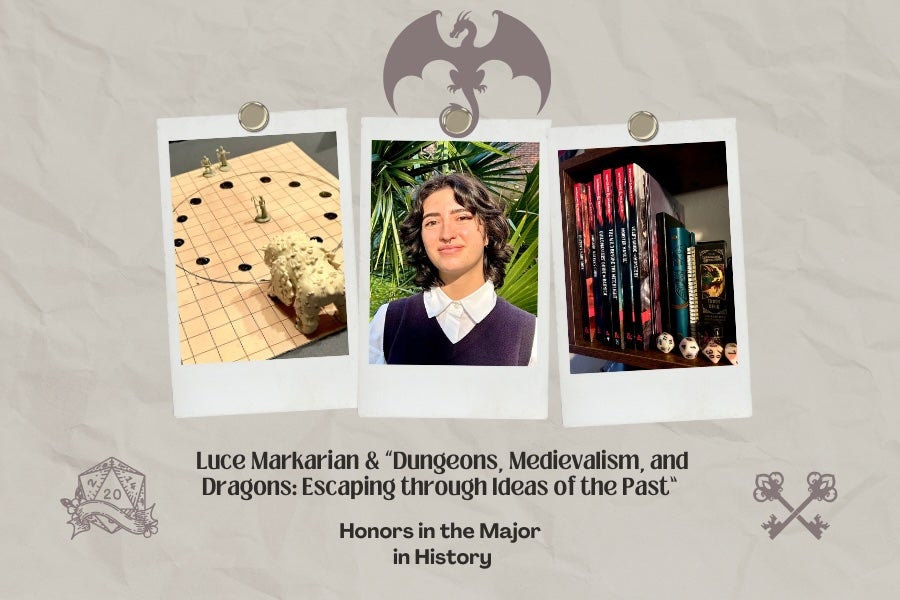
I have always liked stories anchored in history, historical fiction, for example. When I got to middle and high school, my favorite classes were always related to social science and history. In high school, I developed a fixation on the Russian Revolution. I spent time researching it and decided that I would like to spend the rest of my life studying it.
I decided on Florida State because of its history program, which had classes on Russian history. I went to TCC (now TSC) and then transferred to FSU. I still love Russian history, but I soon came to realize that maybe it wasn’t what I wanted to do for the rest of my life.
I took a class on the Crusades, and it wowed me. Everything was interesting, and I was never bored. Though at the time it was harder for me to work with sources that were that old, I enjoyed the challenge and was able to improve. I took more history classes to decide between what topics I liked learning about versus those that I wanted to do more research in. That’s how I realized that I wanted to work more on medieval history rather than modern history.
The Project
The title of my Honors in the Major thesis is “Dungeons, Medievalism, and Dragons: Escaping through Ideas of the Past.” My focus is on the concept of medievalism, the ways in which we imagine the medieval past and how that contributed to the creation of D&D, as well as how D&D nowadays contributes to the concept of neo-medievalism. According to Amy Kaufman this is a sort of medievalism doubled upon itself, an ahistorical idea, a dream of somebody else’s medievalism.
I wanted to look at the way people have incorporated nostalgia into games like D&D and the way the game and rules have changed over time. The creators of D&D borrowed concepts from medieval history and from sci-fi and fantasy literature like Tolkien, Poul Anderson and H.P. Lovecraft. The rule sets constructed were fairly limiting with regards to gender, race, and a morality system known as “alignment.” For example, a character who is “lawful good” may seek to follow the laws and do good deeds, where a character who is “chaotic neutral” may be more suited to following their own whims and interests.
Things have changed over time and editions. Alignment used to be restricted to your race/species, which could obviously pose some challenges. In newer editions, alignment is more of an individual’s choice. However, nothing stops people from playing with older edition rules.
Sources
Aside from sources concerned with the Middle Ages and Medievalism, I relied on the works of Jon Peterson, who has written several books related to the history of D&D and table-top gaming and is very prolific in the matter. I used old D&D manuals, such as the “basic” and “advanced” editions of the game. I also worked with original D&D manuals (OD&D). I also looked through online archives, larger ones like the Internet Archive and private ones kept by fans. After seeing discussion of a zine called the Domesday Book which was central to D&D’s early years, I also looked for copies of that but was unable to get a hold of them. I had to rely on others who had seen copies and written about them, so small forums and archives were very helpful. Then there was Dragon Magazine, published for a time by the companies that published D&D, which I used. Additionally, I drew a bit on queer theory in terms of how some people try to create a more welcoming world versus a more exclusionary one. Getting ahold of the more modern material was not that difficult, but compiling examples of how the game was used was hard.
Narrowing down my research question was not easy either. In the first incarnation, I wanted to see how people used or misused these concepts of medievalism and how much that had to do with a lack of education in medieval history. I wanted to use examples detailed in older game reports that were printed in various zines and look at fiction ostensibly based on D&D campaigns, like Dragonlance Chronicles.
Writing
When I sat down to write, my writing took me in a different direction. I wrote on how people use D&D in ways that are subversive towards or affirm existing worldviews. I read a book by Carolyn Dinshaw in which she talks about the way that the work of the amateur medievalist, and consequently medievalism, fits into the idea of queer temporality. The ideas presented here really resonated with me since part of how I became interested in the Middle Ages before knowing much about it or deciding to study it seriously was through these non-academic works. I felt that the desire for another time and the desire for a fantastic world were very relevant to the impacts that fantasy and medievalism could have, so I decided to focus more on that in my research.
I started my project with Dr. Palmer, and later Dr. Dodds took over. I met a lot with my mentors in the beginning of the project and toward the end. When I started writing, we met frequently to go over my drafts. Being able to talk to him and explain what I was researching and thinking helped me sort out my findings. Dr. Dodds was incredibly helpful. I could not have finished the project without him.
The hardest part of the project was not the research, not the thinking about it, but the writing. I had set up my course schedule to have a good amount of time available for the project, and I almost got it done by the earlier deadline I had set for myself. But I was also continuing with my job in FSU Library’s Special Collections, and I am applying for graduate school — so there wasn’t as much time as I had hoped for. I found it difficult to sit down and write. Dr. Dodds told me that the thesis was already in my head, that I should just sit down without any notes or sources and just write it, and then go back and correct my paper. Honestly, I had never done that with an academic paper before, but it worked great for me, to do all my writing in a burst and then go back and make sure I got it all down correctly.
Once I had figured this out, it was also easier for me to divide the paper into chunks and work on individual sections. I got a timer app called Focus Friend which involves a little bean that lives in your phone, and he needs to knit socks to be able to decorate his house. Unfortunately, he can’t knit socks while you’re on your phone. So, when you set a timer, Focus Friend can block out other apps temporarily, and lets the bean knit away. It made me focus on writing for a set time and let me decorate the bean’s living space. So, I did my writing for a sort of Tamagotchi on my phone.
Advice
My advice to fellow students thinking about doing an Honors in the Major project is to take your senior seminar class first. I did not, but a senior seminar would probably have taught me skills that I had to learn on the fly while writing my Honors thesis. My other advice is to take really good notes. If you are not a good note-taker, learn to take good notes. If you don’t know how to annotate things, learn to annotate. It will be invaluable when you start writing because you will remember what you were thinking when you were doing the research.
Completing the Honors in the Major project gave me long-term research experience. It has also introduced me to the problem of how the medieval past is used and portrayed in games. Many successful games are set in the Middle Ages, or at least an idea of it. It is important to remember that this past was a real place where real things happened, in a world that was different from ours and yet led to today. When games use images and motifs from the Middle Ages, we should be aware that the historical settings described are usually more a caricature of the medieval past than how it really was.
During the time I worked on the project, I discovered a new research interest. I came to realize that I want to research religion during the Middle Ages, specifically, medieval Christian monasticism and ideas of gender within the clergy. I am hoping to work on that for my M.A. I am applying to graduate programs in Medieval Studies. Because of my job in Special Collections working with manuscripts, I am also interested in pursuing a master’s degree in library science. I’d either like to be a professor or work as a curator of medieval manuscripts. I want to make knowledge about the Middle Ages more widely known.