
Honors in the Major - Jacob Rardin & “The Chase for Christ: An Examination of Religious Themes in the Medieval Hunt”
I have been interested in history since I was very young. In high school, I was very good at AP U.S. History. However, coming to college, my mom wanted me to major in a STEM subject. I came to FSU as a biology major and graduated in that field in Spring 2024. Somewhere, during that time, my mom had a change of heart and suggested I major in History. At that time, I decided to complete the biology major, and I re-enrolled for a second degree. I graduated with a B.A. in History and a minor in classics in Fall 2025.
What is your Honors in the Major project about?
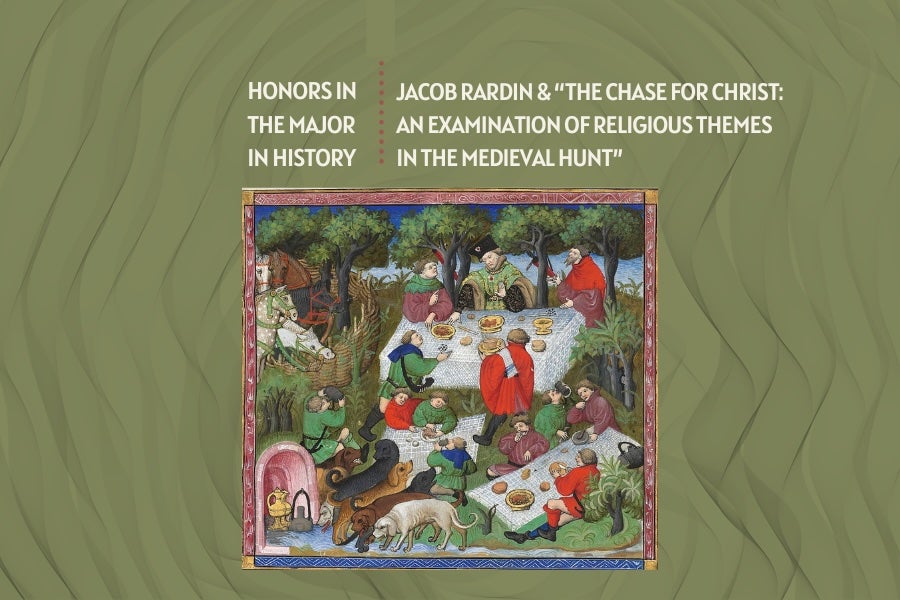
I worked on medieval hunting. I explored religious themes within the medieval hunt, specifically in late medieval Britain. The hunt I am looking at is called the Par Force de Chiens hunt, an aristocratic pursuit with hounds. The hunters on horseback followed their game over great distances. The animals hunted were red male deer, harts, ideally with antlers with at least ten branches. The game was killed and cleaned right in the field.
I was interested in this topic because I grew up in a rural area where most people hunt. I knew a lot about hunting to begin with. But I also started a job at Pebble Hill, a hunting plantation between Tallahassee and Thomasville. I got interested in the types of hunts organized at Pebble Hill, and I noticed that they do quail and fox hunting. I had taken classes on medieval history with Dr. Palmer and Dr. Dodds, so working on the medieval hunt allowed me to combine all my interests in one topic.
What kind of documents did you look at?
I focused on medieval hunting treatises. I discovered very quickly that every secondary source I consulted went back to two sources. One was the "Livre de Chasse" (ca. 1387-1389) by Gaston Phoebus and "The Master of the Game" (ca. 1406-1413) which is an English translation of the Livre de Chasse done by Edward of Norwich. Edward’s translation is curated; he left some material out and added other information that was pertinent for England.
Gaston was obsessed with hunting. His text covers the hunt of every type of game that could be found in Europe, way beyond the limits of France. At the end of "The Master of the Game" there is a detailed account of how to conduct the Par Force de Chiens. The other documents I looked at were the fourth Lateran Council (1215) which addresses hunting briefly, some texts by Thomas Aquinas (1225-1274), and the 14th-century poem "The Parlement of the Thre Ages.” I was able to read the sources that were in English — even older forms, but those in middle French or Latin were harder to digest.
Dr. Dodds pointed me to the International Medieval Bibliography, a database for articles on medieval history. I found a lot of useful secondary sources there, and these helped me narrow down my project. Finding primary material was the biggest stumbling block for my project; I wish I had access to more primary sources.
What is your central argument?
I am arguing that the Par Force hunt is intrinsically tied to religion. There were vocal skeptics with regards to hunting within the Catholic church, and in response to that the aristocratic hunters began to include more religious elements into their hunt. We have direct evidence for that both in the texts as well as in visual depictions. On the one hand, commentators described the hunt as an intense form of prayer. They linked being out on hunt to being in tune with nature and going back to a state prior to man’s fall from grace. On the other, we have hunt rituals saturated with religious meaning.
For example, at the end of the hunt, we have the curée ritual, which is the ceremonial dismemberment and sharing of the hunted animal, often with specific parts given to key participants: hounds, attendants and noblemen. After the ritualized unmaking of the body of the killed animal, it was put together again. The hounds were made to baye at this body, horns were blown, the head of the hart raised above the body and then organ meat mixed with bread was given to dogs. This can be seen as mirroring Christian liturgy, transforming the violent act of the hunt and kill into a spiritual observance. The wild beast becomes a sacred feast paralleling the transformation in the Eucharist.
While the Fourth Lateran Council stipulated that the clergy must not hunt, a lot of high-ranking members of the clergy did regularly. Not only did they come from elite families, but participating in this aristocratic hunt was a natural way to meet and establish connections to other members of the nobility. There are also two saints associated with hunting. Saint Eustace, a Roman general named Placidus, who was martyred under Hadrian. His conversion story is very representative of the religious elements in the hunt. He was out hunting and separated from his party when he pursued a hart. As the animal turned to Placidus, he had a cross between his antlers and God spoke to the Roman general and invited him to become a Christian. The other saint is Saint Hubert who was the bishop of Liege. His hunting experience was similar. However, Saint Hubert was hunting on Good Friday, and when God speaks to him through the hart, he is being scolded that his actions — hunting on a holy day — will lead him to hell.
How difficult was it to stay on top of things?
I did my Honors in the Major project across two semesters and one summer. In my second semester, I also did my senior seminar. The workload was intense at moments. There were weeks when I just sat down and wrote. It became easier, the more I had written. I could come back to my thesis after class and find my way back into my argument. Finding primary sources in languages that I could read was the hardest part of my project. Dr. Dodds suggested I comb through my secondary material for quotes of primary sources and use those for my work.
What advice would you give other students who are thinking of doing an Honors in the Major project?
Read, read, read. Get started with the reading as quickly as possible. Do as much as you can early on to help refine your project to something for which you can find sources. Use the summer semester too, even if you are not taking classes. Take good notes on your reading. Then you will be able to connect the sources with each other and craft your argument. If I could do it again, I would frontload the reading much more.
What’s coming next?
I graduated in December 2025, and I will continue with my work at Pebble Hill. I am planning to apply for grad school in History for Fall 2027. I would like to spend more time researching the medieval relationship to the natural world.