
Honors in the Major interview: Alejandro Valdivia and “Memories of El Cid: Notions of Holy War in High Medieval Iberia”
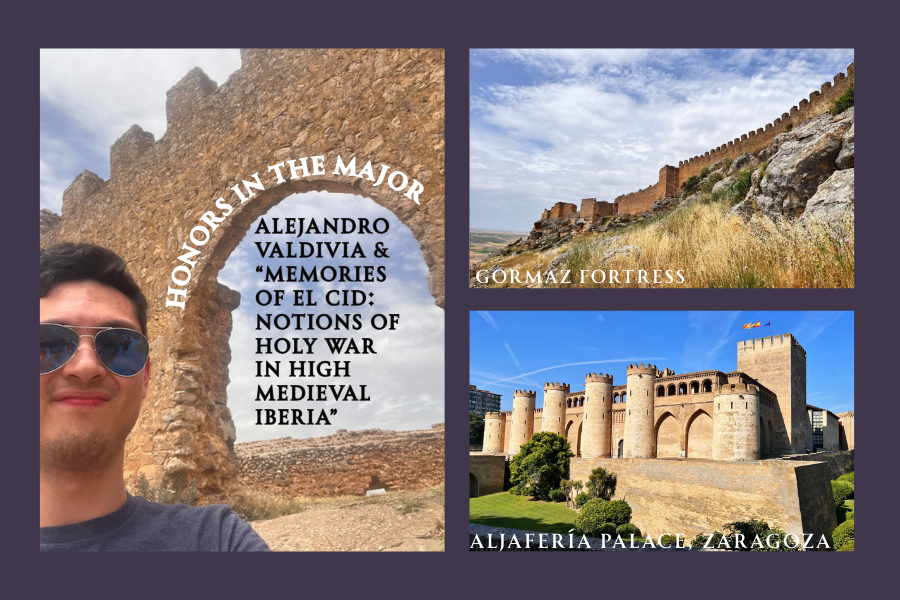
My Honors in the Major thesis is an exploration of how the approach to combating Muslims in Al-Andalus changed from the pre-Crusading era to the 1300s from the Iberian Christian perspective. I used specifically the “Cidian Canon,” which is a body of works and myths about El Cid who was a knight in the 11th century.
I thought of this project in a Spanish literature class. The very first thing we read was the 13th century poem about El Cid, and for my final paper I did a comparison between El Cid the historical man and the Cid of the poem. While I researched the real Cid, I learned that he had worked on the Iberian frontier, on both the Christian and Muslim sides, making pragmatic decisions about employment and political alliances. During the 11th century this behavior, this flexibility in which side to fight for regardless of religious affiliations, was acceptable in the frontier culture of Spain. But by the 1200s, many rulers as well as the Catholic Church no longer tolerated these actions, and Christians who worked for or with Muslims were seen as traitors and justified targets of the Crusades. So based on his actions, El Cid should have been condemned and excommunicated, but it is exactly at this time that the poem about him becomes popular and the myth about him develops. My research asks: how and why did this happen?
What sort of sources did you look at?
Dr. Dodds recommended some of the books I read initially, like Richard Fletcher’s Quest for El Cid. That book contained an extensive section on sources, and I used them to get started. Finding primary sources that were near contemporary to El Cid was not easy. The majority of these contemporary sources (three to be precise) were written by Muslims. This is because Andalusians had an established writing tradition, shared with the rest of the Islamic world. The first source was written by Ibn Bassam (1058-1147), an Andalusian born in Santarem (now Portugal). The second was a book written by Ibn Alqama (1036/7-1116), a diplomat and scholar living in Valencia. While his original work is lost, scholars have reconstructed it through the work of a later Maghrebi author Ibn Idhari and Alfonso X’s History of Spain. These two sources detail Rodrigo’s rise to power and his subsequent takeover of Valencia.
The third source is not directly about El Cid but deals with contemporary politics. It is the memoires of Abdallah Ibn Bullugin (1057-1090), the last king of Granada before its takeover by the Almoravids. While he does not reference El Cid, he showcases the political climate at the time. He describes a frontier society in which interfaith collaboration is quite normal, albeit not without Christian desires to expand into Al-Andalus.
I read these sources in translation because I don’t know Arabic yet. I am hoping to learn it in the future. I found an English translation of Abdallah’s text. I found a Spanish translation of Ibn Alqama’s text. The second and third sources were very hard to track down. It was only when I went to Spain in the summer that I found a copies, and, in the case of the second source, not even a copy but an excerpt of the text in a larger book. It was in Spanish too, and I did my own translation.
I also consulted the Historia Roderici, a Christian anonymous history likely written by somebody close to Rodrigo, but which has since been subject to later alterations. Historians have dated the core text to sometime in the early 12th century, a few decades after the death of Rodrigo. While the source’s precise dating remains a subject of debate, it contains enough vestiges of an earlier, core text to be useful for understanding the ideologies and realities of warfare during and shortly after the life of Rodrigo, from a Christian point of view.
How important was it for you to travel to Spain for research?
I traveled to Spain in the summer for two weeks. For one week, I was able to access the Spanish library system. I went to the National Library in Madrid, where I worked in a high-ceilinged reading room built in the late 1800s. The setting made me feel very professional. I had to request the books in advance, and they brought them to me. The hall was very quiet, and I got to read through my material. This was my first experience of working in a research library.
During the second week, I traveled in the footsteps of El Cid. I went to places that he besieged like Saguntum, to places that he ruled like Valencia, and to fortresses he owned like Gormaz. I visited Burgos too, which was the political capital of Castille at the time. Standing in places where the Cid had been, seeing the landscape of the region, made it a lot easier to understand my written sources. It allowed me to visualize the frontier society of the time of the Cid. You can see the castles dotted across Spain, and each one was a place from which authority could be exerted. Then you can see the green and flat plains of Spain which facilitate the movement of troops and supplies and also supports trade. This trip was a great way to round out my research, to explore the actual physical space. I had won the departmental Ausley Award for Honors in the Major students in the spring, and that money helped pay for my trip.
What was the biggest challenge you had to overcome in your work?
The biggest challenge was to know when to stop looking for more information. Dr. Dodds had warned me about that in the beginning: The danger of following footnotes to more footnotes to further footnotes until you have a stack of notes that is too big and unwieldy to manage. And sure enough that was starting to happen to me because I kept finding more and more things. I decided that the material I brought back from Spain will be the last addition to my source base. I am thankful that I followed through on that as it was more than enough material to work with.
How did you prepare for the defense?
One of the things that was important for me to do alongside writing my thesis was to give presentations of my work. I participated in the Summer Research Day where I got to talk about my project. While I had done a poster board presentation for an Undergraduate Research Opportunity Program project earlier, which made me explain my work to a non-specialist audience, this was the first time talking about medieval history to a general audience. I had to simplify my talk to make it comprehensible to others. And then a few days before my defense, I presented my work to a group of other students interested in medieval studies (we are trying to set up an RSO) and that was a good practice session for the HITM defense. The defense itself wasn’t easy, but I did feel prepared.
What advice would you give to others who might be thinking of starting an Honors in the Major project?
Honors in the Major in History is a fundamental steppingstone for people who want to explore history in a more professional context. It is a big project though, one that demands a lot from you but also one that it is easy to relegate to the back and forget about for a while. The most important thing then, just as with the senior seminar, is to pick a topic that you are passionate about, and that you will want to return to work on. I had an interest in Iberian history, and I had the language skills to work on primary sources.
My advice on how to avoid procrastinating on the project is to treat it like a real scheduled class. Make sure you give yourself at least the same amount of study time for the HITM project as you would for a regular class. I set up meetings with my mentor and other members of my committee throughout the semesters to have deadlines for producing work. It was my way of holding myself accountable.
Lastly, if your project is ambitious and you might have to travel to access sources, I would advise you to spread your Honors in the Major across three semesters or at least two semesters plus a summer. I personally think that is a healthier approach than trying to complete it in two semesters without a big break. Taking more time lets you really understand your topic without dreading having to write about it.
What's coming next?
I have been thinking about what to do next and have decided to apply to M.A. and Ph.D. programs. It is not something I am doing lightly, but Dr. Palmer once told me, if you can go to grad school, and you want to, then you should do it. It is scary but I am applying.