
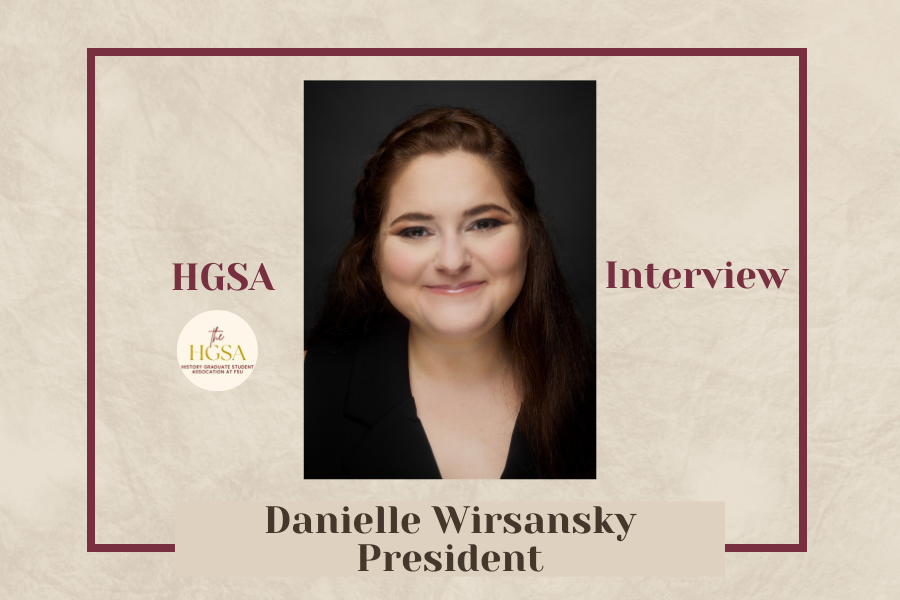
History Graduate Student Association Interview with Danielle Wirsansky, President
What topic are you working on for your Ph.D. dissertation?
My Ph.D. dissertation examines the gendered experiences of Special Operations Executive (SOE) agents during the Second World War, particularly those working in the F Section of occupied France. I’m interested in how gender shaped not only the recruitment, training, and fieldwork of these spies, but also how it influenced their capture, imprisonment, and postwar memory. Many of these women defied expectations of what women were “supposed” to do in wartime, and their courage was often recognized only long after the fact. Through my research, I hope to shed light on the hidden hierarchies, biases, and acts of resilience that defined their stories and to challenge the narratives that have traditionally sidelined women’s roles in intelligence history.
What minor fields did you choose for the Ph.D. program?
My minor fields are Public History, Gender and Sexuality, and War and Society. I chose them because they all intersect naturally with my main field of Modern European History and with the kind of stories I love to tell. Public History was especially important to me because I use theatre as a platform for historical storytelling— turning research into something people can experience and connect with. Gender and Sexuality are at the heart of my work on women spies, while War and Society provides the larger context that ties it all together. For me, these fields complement each other perfectly and help me look at history through both an analytical and deeply human lens.
What is the difference between doing History as an undergrad and as a graduate student?
I actually didn’t major in History as an undergrad—I double majored in theatre and creative writing, with a minor in History. My real introduction to historical research came from working as an undergraduate research assistant for Dr. Nathan Stoltzfus, who’s now my dissertation adviser. That experience gave me a foundation in how historians think and work.
When I started my M.A., it wasn’t at all what I expected. I thought I’d just be learning more about the history of the period I study. Instead, I realized the real focus was on learning how to think, write, and speak as a scholar—how to craft your own voice within the discipline and navigate academia itself. It’s less about memorizing facts and more about joining a larger conversation.
What advice would you give to an undergraduate who is thinking about grad school?
My advice would be to just go for it—you lose every battle you don’t even try to fight. If graduate school is something you’re curious about, take the first step and see where it leads. You don’t have to have it all figured out from the start; you’ll learn as you go. Reach out to professors, get involved in research, and let your curiosity guide you. Sometimes the best opportunities come from saying yes before you feel completely ready.
How did your interest in history start more generally?
My path to history was a little unorthodox because I didn’t major in it as an undergraduate—I actually studied theatre and creative writing. But history has always been woven into everything I do. I even won a history award in high school, and my Girl Scout Gold Award project was a documentary about Jewish WWII veterans in Jacksonville.
When I came to FSU, I joined the Undergraduate Research Opportunity Program and connected with Dr. Nathan Stoltzfus, which was my first real experience with historical research. That led me to intern for the Holocaust Education Resource Council, where I saw firsthand how storytelling and history can come together to educate and inspire. Over time, I realized that all my creative projects— my plays, musicals, and photography—were really about history. Pursuing a graduate degree in history felt like the natural next step to truly master the stories I wanted to tell.
What do you do for “fun” history nowadays?
For me, “fun” history is still all about my women spies—they have some of the most incredible stories! One of my favorites is Nancy Wake, who was so fierce that the Gestapo nicknamed her “The White Mouse.” She once rode a bicycle nearly 300 miles through occupied France to deliver a vital message after her radio operator was captured—and still managed to look completely unbothered about it afterward.
Beyond that, I love diving into unusual or overlooked corners of history—like queer British women doctors in WWI, the Holocaust history of Albania (the only European nation to end the war with more Jews than it started with), and the Rosenstrasse Protest in Berlin. Lately, I’ve also been exploring the ethics of Holocaust-era human remains and artifacts through my play Sterling Legacy, which premiered at Palaver Tree Theatre last month, and the postwar experiences of Jewish survivors in East Germany, which are at the heart of my musical Annex that opened at FSU last month too.
I guess my version of “fun” history is when I can take the past and make it feel alive, urgent, and deeply human— whether that’s through research or on stage.
What do you do as an HGSA officer?
As the president of the History Graduate Student Association, I help represent graduate students in the Department of History and make sure their voices are heard. My job involves organizing meetings, coordinating with faculty, and overseeing HGSA events—like assisting our vice president with our annual graduate student conference and social gatherings that help build community within the department.
A big part of my role is also creating opportunities for professional development and connection—whether that’s through panels, workshops, or just helping new students feel at home in the program. I work closely with our amazing team of officers, our faculty advisers, and the department leadership to make sure HGSA continues to be a space where graduate students feel supported, engaged, and part of something bigger than themselves.
How do you see HGSA make a difference to grad student life?
I think HGSA makes a real difference by creating community and connection among graduate students. Grad school can sometimes feel isolating, especially when everyone is deep in their own research, so HGSA helps remind us that we’re part of a supportive network. Through social events, professional development opportunities, and open communication with faculty, we help make the department feel more collaborative and approachable.
We also advocate for graduate students in departmental discussions, making sure their perspectives are heard when decisions are made. Whether it’s helping organize the annual conference, hosting events that bring together grads and faculty, or just being a space where people can share challenges and successes, HGSA is about building a sense of belonging and community within the department.
What would you tell an incoming graduate student about joining the HGSA?
I’d tell incoming graduate students to get involved with HGSA right away—it’s one of the best ways to feel connected and supported in the department. Graduate school can be intense, but HGSA makes it easier by giving you a community of people who understand what you’re going through. Whether you come to social events, help with the conference, or just stop by for pizza at a meeting, it’s a great way to meet people across cohorts and share advice, ideas and encouragement.
HGSA also gives you a voice in how the department operates. It’s an opportunity to make real contributions while building leadership and collaboration skills. Most of all, it reminds you that you’re not doing this alone— you’re part of a network of historians who have your back.