
#SeniorSeminar - Elizabeth Struble & “Margaret Thatcher and Bob Geldof: The Intersection of Pop, Politics, and Humanitarianism”
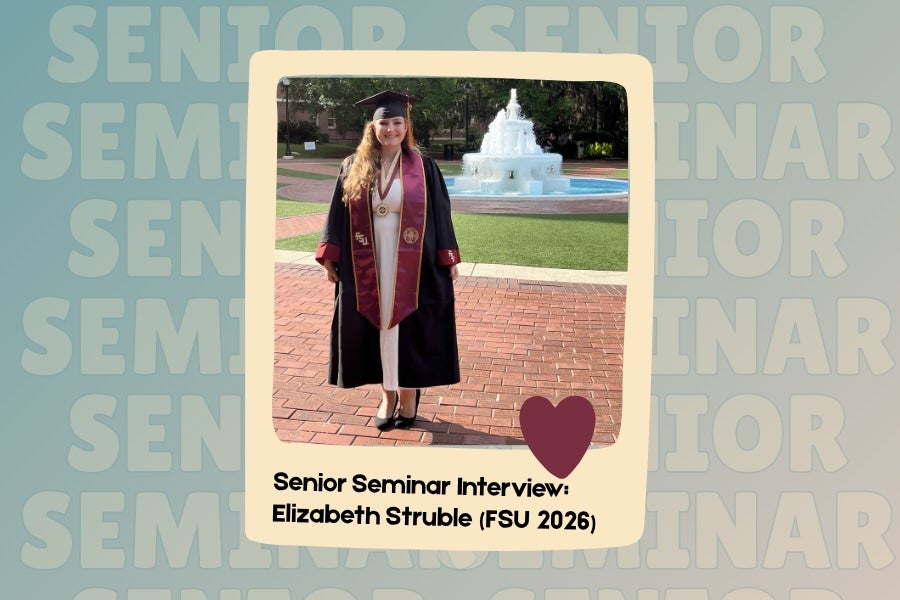
My dad was a History major who went to law school. He told me not to follow in his footsteps, but I did anyway. Around sophomore year in high school, I decided I wanted to go to law school. And History has always been my favorite subject since I was six years old. I enjoyed the research and writing part. I don’t think I have a particular subject or theme in History that I gravitate to. In my sophomore year, I did a project on the Chernobyl nuclear accident, and that topic grabbed me very much. Besides that, I have done a bit of reading on women in history. I jump around a bit in my historical interests.
I am from St. Louis, Missouri, and I applied to universities all over the country. FSU was one of them. To be honest, coming here was a financial decision. I got a great scholarship from FSU.
What drew you to this specific senior seminar?
I took this class because of Professor Upchurch. I had not personally taken a class with him but several of my friends did. I make most of my course decision based on the instructor, not so much on the topic. Additionally, bringing it back to my dad, he is really into British history. I thought he would be tickled to see me take this class.
What topic did you decide to work on?
I jumped around a lot. Originally, I was going to do something about crime because my other major is criminology. I thought that I would be able to bring some background information to the project that way. But what I ended up working on has a different history. Back when it snowed in January 2025, I was stuck in Atlanta with my aunt. While we were waiting for the snow to clear, we watched a three-hours long documentary on Live Aid in 1985. This was a two-venue concert event to fundraise donations for people living during a period of famine in Ethiopia. It was largely organized by Bob Geldorf of the Boomtown Rats. The documentary contained an interaction between Margaret Thatcher, then the prime minister of the U.K., and Bob Geldorf. There is palpable tension in the interaction between these two people, and since then, I have been interested in finding out the story behind this. I would have loved to have been a fly on the wall during that conversation.
I thought of the documentary and the Geldorf-Thatcher interaction again, when I was trying to define my research topic. I began to review the literature to see how much work had been done on Live Aid because it was such a famous event. There was a lot of material, even on the interaction between Thatcher and Geldorf, but I noticed that the pieces only ever covered one person. There were not many which addressed both of them, and those that did, were very one-sided. There was a gap in the research looking at Geldorf’s role in Live Aid, the Ethiopian famine, and Margaret Thatcher from their own perspectives. I decided to explain how they came to their specific, very different views on the Ethiopian famine which shaped their responses to it.
Margaret Thatcher was anti-foreign aid. Britain was the first country to respond to the Ethiopian famine and sent aid, but it was not a very large amount. Given the context of the Cold War, Thatcher was hesitant to send money to a Marxist government. Geldorf saw it in purely humanitarian terms. He went to Ethiopia and then created Band Aid, bringing together a group of prominent musicians to record “Do They Know It’s Christmas?” in November 1984 to raise money for Ethiopia. While Thatcher had to consider the political ramifications of sending aid to Ethiopia, Geldorf was only concerned with the humanitarian side.
What sort of material did you use to research such a recent event?
My best sources came from the Margaret Thatcher Foundation Archive. They have a lot of declassified government documents, even notes that she wrote during cabinet meetings as well as her letters to the people she was negotiating with in Ethiopia. I also used the book Statecraft by Thatcher in which she discusses international relations in general. These sources helped me to identify her general attitude toward foreign aid within the Cold War context.
Bob Geldof wrote an autobiography which proved a great source. I also found two other sources composed by people involved in Live Aid. One was a DJ and the other was a member of the organizing team. That gave me a couple of outsiders’ perspectives.
For secondary literature, I relied on texts looking at the emergence of these humanitarian celebrities, more a theoretical-cultural account. There are no entire books dedicated to the history of Live Aid. It was more a section within a section in a book chapter.
I ended up with around 40 sources overall. Most of them were online.
What challenges did you encounter in researching this topic?
There were a lot of things that just fell into my lap, which was great. No complaints. The main challenge was that Live Aid was such a recent event, many people today watched it on TV. It is considered more of a cultural phenomenon not a historical event with serious political implications. People who wrote about it also participated in it – or watched it live, and very selectively picked out pieces from the event to tell their own stories.
I think writing the paper was what I struggled with the most. This is the biggest paper I have ever written. For shorter papers, I usually sketch out a full outline based on everything I know, and then I start writing. I tried doing this here, but it did not work. I had to switch my strategy to researching and writing as the paper unfolded. That was the most uncomfortable experience I had in the class. But when I did that, I found that writing and refining was a continuous process. It went against everything I had ever done before. It was great to have that experience in this course, to trust my writing and know that I will be able to pull things together as I go.
I am the type of person who works in sporadic bursts. There was one day, I spent 14 hours working on the paper, but for each day like that, there were three days that I did not touch the project. It is important for me to let my work sit for a certain amount of time before going back to it. If I don’t do that, I will not make any progress. I know that I have to wait until I am in writing mode before starting to write again, and I need to try and stay in that mode for as long as possible and then take a longer break.
Dr. Upchurch took us through different ways of writing in the first part of the course. We learned how to structure an argument. We read excerpts from different books on historical writing. Some things were intuitive; I had known them before but not really thought about them in a deliberate way. One thing we did was read part of a speech by Winston Churchill and we dissected it in detail. We identified how each part connects, and how each sentence connects. How the beginning of each sentence connects to the end of the last one and the one before. I went through my paper and reviewed if my sentences connected effectively to the ones before and when they did not, I edited my text. Finding the mechanism underlying effective writing was eye opening. I learned more in my senior seminar about how to write than I have in all my high school and college experience combined.
What surprised you about the senior seminar process?
The biggest thing that struck me in the senior seminar class was that I had a whole semester to work on one topic. For every paper I have ever written before, you get the prompt maybe a week or ten days in advance, then you need to research the information, and then you have only a short amount of time to write the paper. Having an entire semester allowed me to finally fully explore a topic and read absolutely everything that had been written about it. And then use the information to craft an original argument. It allowed me to see the big picture and not just a small snippet that I normally feel I get to see. We had to submit a partial rough draft in which we had written two sections, then a complete draft, and the final paper.
Did the presentation to the group help you refine your arguments?
I was so busy working on that paper, I did not even think about the presentation until the day before. I have done a lot of public speaking, that was not an obstacle to me. I competed nationally in mock trial in high school. I felt OK about working on it at short notice. I found that transforming my account from something written to something spoken helped me understand the essence of my argument. When writing my paper, I felt that I was trying to do a lot of things at the same time, trying to hit a lot of points. Synthesizing my paper into a ten-minute presentation that had to be engaging and tell my story, made me see what I wanted to tell my audience. I also love making slide presentations. It is a very relaxing thing for me. I enjoyed the process of turning something that was complicated into something that was easily digestible.
What advice would you give to History majors about taking the senior seminar?
My biggest piece of advice is that at a certain point, you just must stop doing research. You cannot look for or at another source. You cannot go through your paper again to see if you missed something. I was doing that repeatedly. I found that I kept on looking for a slightly better worded quote, a statement that was a little bit more applicable, but at a certain point, you have to stop researching and brainstorming and outlining, and you just have to write.
The senior seminar has renewed my love for history. It made me realize that my interest in history goes beyond the fascination that was convenient for my major to prepare me for law school. I enjoyed the research and had to pull myself away from it. I did not expect a class where I had to write such a big paper to rekindle my passion for history. It was the best academic experience that I had in college. I cannot thank it enough for that.
What is coming next for you?
I am taking a gap year. I moved back to Missouri. I have a job waitressing and am looking for a legal internship. The year is dedicated to taking the LSAT, applying to law school, and making some money. Then I am going to law school somewhere close to home. Through my criminology courses I have realized that I definitely want to go into criminal law, but I am not sure about criminal defense. Right now, I am interested in becoming a prosecutor.