
Senior Seminar Interview with Larry B. Harper (FSU 2026)
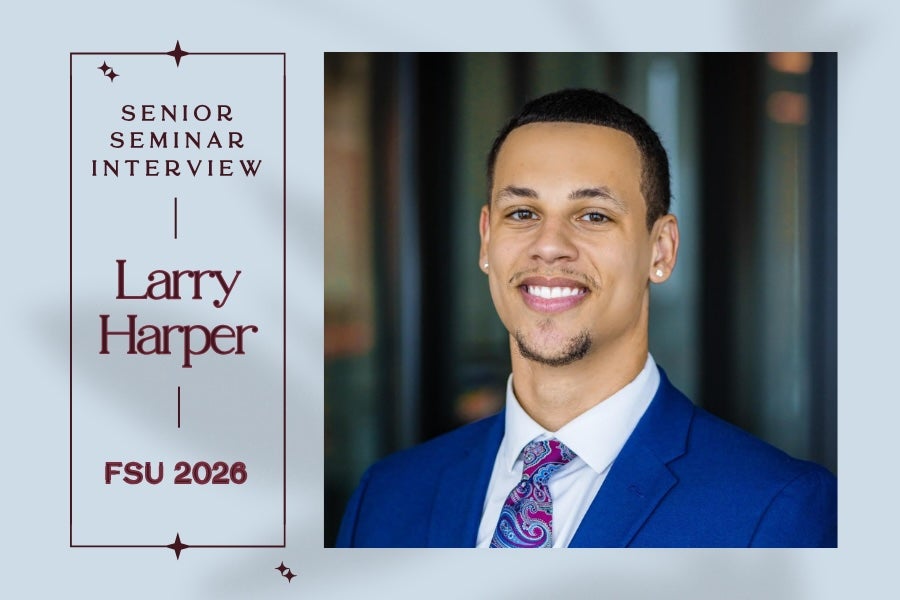
My interest in coming to FSU came from my interest in pursuing an intellectual career. Up to my sophomore year in high school, I did not think about what would come after grade school. However, that year, I met a guy who influenced me to take reading seriously. At the time, I produced political content and he insisted that I read non-fiction books: philosophy, politics, economics, epistemology, ethics. Reading made me realize that there was a world of ideas out there that directly influenced the world we live in. I decided I wanted to be a part of that intellectual sphere. I applied to several schools in Florida and got accepted by FSU. I researched the school and found that it offered the real collegiate university experience that you see in movies and on TV. As a first-generation student, and someone who did not travel much, I wanted that experience. Going to an actual university was a big step for me. I came in as a philosophy major, then switched to sociology, and then to History. I have not looked back since.
I am interested in the intellectual history of America between the 1830s and the 1870s, and I particularly focus on the intellectual history of the Civil Rights Movement(s) during that era. In my view, there are two layers of history, and they are taught differently. There is history qua history which is pretty much the chronology of facts and events. But then there is intellectual history, being able to trace the origins of ideas and figure out how these ideas influenced human actions and the consequences of those actions. Ultimately, understanding that the primary cause of human events are the ideas that people hold.
What topic did you work on for your senior seminar?
Many years ago, I read a book by Thomas Sowell, Black Rednecks and White Liberals (2005). The first chapter with the same title argued that modern Black culture has its origins in the cultural attitudes of Celtic immigrants: Scottish Irish, Welsh, and northern English who came to America in the 1700s. Some of them became owners of enslaved people, who passed their cultural attitudes on to their enslaved workers who then passed them on generationally, ultimately leading to modern Black culture. My original project was to evaluate Sowell’s book; to go through the secondary and primary sources to validate that cultural transmission chain he sets out. Out of that grew my actual project, in which I researched the factors that dictate or influence cultural transmission altogether.
How did you get started with the project?
The first thing that I did was identify the people and sources Thomas Sowell used in his work. He referenced Frederick Law Olmsted's travel accounts from the 1850s in which Olmsted journeyed through the antebellum South. He referred to "Cracker Culture" by Grady McWhiney. And he also referenced "Albion’s Seed: Four British Folkways in America" by David Hackett Fischer. These were the main sources that Sowell relied on for his work.
But Sowell did not mention secondary sources that conflicted with him. I had to find those sources myself. I searched for authors who critiqued Sowell’s work and then read these works too. After that, I looked at the academic landscape at large to see who was working on this specific era in American history and read their works too: Jennifer Morgan, Orlando Patterson, Christopher Brown to name a few. I also discovered a primary source pool: Arthur Young’s "Tour in Ireland" (1780), and the WPA Slave Narrative Collection, conducted between 1936 and 1938 by the Federal Writers' Project. The sources were largely online.
What were your findings?
My findings were about the scholarship behind the idea of cultural transmission. Thomas Sowell does not have an explicit theory of cultural transmission; he considers the developments more as cultural diffusion. In his case, the two groups, Celtic immigrants and enslaved people, came together, and they diffused their cultural patterns and attitudes amongst themselves. Sowell did not have a robust framework of how this happened; his work relies more on proximity and frequency of contact.
A more theoretical framework was provided by Ayn Rand (1905-1982). She had a concept of psycho-epistemology in which she details the relationship between the conscious and subconscious mind, exploring the subconscious stores knowledge and modes of thinking that can be called on by the conscious mind. Rand’s theory of cultural transmission is woven throughout her work. She also focuses on the role of public intellectuals. As leaders of cultural movements their ideas are dispersed through society, and in a circular process, those premises that are held and practiced by society also then shape individuals’ default psycho-epistemology e.g., what they are likely to take seriously, take without evaluation, etc.
There were other authors that talked largely about the same topic indirectly. Orlando Patterson showed that cultural transmission never happened between these two groups because the conditions for successful transmission were not met.
What were the major challenges you encountered when you were doing your research?
The synthesization was probably the hardest part. My topic was very complex and abstract, looking at the factors that influence cultural transmission. I asked what is culture? What are the attitudes we are looking at? What is the psycho-epistemology of a person that needs to be primed to accept culture? Those are large questions within themselves. Since I had been thinking about this project for a while, I had a large amount of data to synthesize.
The other challenge was not to write 400 pages. I ended up with 30 pages but that is still a large paper. I could have written more; I cut out a whole section to stay at 30 pages. I like to outline the whole paper, and then I take each section and put it into a separate Google doc. After that I write a miniature essay on each topic. Once I am somewhat satisfied with my miniature essays, I put them all into one file, and then I edit them line-by-line to make them cohesive. I tend to first write the text and add in quotes as I remember them or from my notes. Then, when I go through the paper a second time, I put in the notes and verify the quotes.
What was the most fun part of the semester?
The most fun part is having the freedom to do a topic that you genuinely enjoy. I had registered for a senior seminar before, but I was not able to pursue the topic that I wanted, and so I dropped the class. I wanted to work in the realm of intellectual history, on ideas and how these impact actions. I wanted to ask: what are ideas? Can you trace ideas that caused something and see how they diffused to a wide variety of people. That is the most fun thing for me: tracing ideas.
How did you manage the time commitment of the senior seminar during the semester?
I was lucky that I had a desk job, and so I could spend some time on schoolwork even while at my paying job. However, during my time writing the paper, I was also the president of my fraternity, and I was serving on a multitude of e-boards for extracurricular organizations, alongside with running a business full-time. All those things take time. There were moments during the semester when I had to ask Dr. Upchurch if I could streamline the readings for the week because of assignments due in other History classes. The only way to read everything and engage with all the reading is to stay off social media. If you are on social media all the time, then you don’t have that time for reading for class.
How helpful was doing a presentation in class about your topic?
I have done a lot of public speaking; I have won a national oratorical competition for my fraternity. I am used to speaking in front of larger audiences. If you are not used to speaking in front of people, then the presentations are very helpful. You must crunch a 20-to-30-page paper into something concise that can be explained in ten minutes. You have to explain what the original problem was that you wanted to solve, how you began, in which ways you have changed directions, and set out your conclusions. Being able to consolidate your paper into a ten minute talk is very helpful for clarifying your ideas.
What advice would you give to History majors who might be thinking about taking the senior seminar in fall?
Well, if you are a History major, you have no choice but to take a senior seminar. My advice is to get acquainted with the professor beforehand. Know how they teach and get them to greenlight your project idea before you take their class. I knew what I wanted to study for my senior thesis many, many months in advance. I had all the resources lined up. While I refined my topic, I stayed within the same theme. I talked to Dr. Upchurch over a year before I took the class to see if my project would fit. So, talk to the professor to see if they accept your ideas as fulfilling the course requirements.
Then start doing preliminary research. Just dibble and dabble, read an article here, a book there. Start getting familiarized with the field and begin narrowing down the specific theme you want to work on. This will make the whole class easier. Because if you come to class on the first day and know what you want to do, you can dedicate more time to the material that is discussed in the weekly meetings. You will read things on how to write history, how to source and cite texts, and you will work on how to write a good history paper. You will need to work on your own project and on the class material. As the semester progresses, so will you and your paper.
If you could go back to the beginning of the semester, would you do anything differently?
I would start my paper earlier. In the classroom, we focused on consuming and talking about history. But to write a 20-to-30-page paper well, you have to have enough time. As History majors we are used to writing five-to-seven-page papers. Those are essays that I can write in a day. But when you multiply that by three or four, you are talking about a paper in a different league.
What is coming next for you?
I graduated this spring. I will work full-time for my company. I am also considering becoming the director of an entrepreneurship-based nonprofit in Tallahassee. I am also planning on working for the Small Business Development Center at FAMU, learning how to help people who have ideas for setting up businesses and teaching them how to kickstart their project. Down the line, I would like to get an MBA – but that is a later matter.