
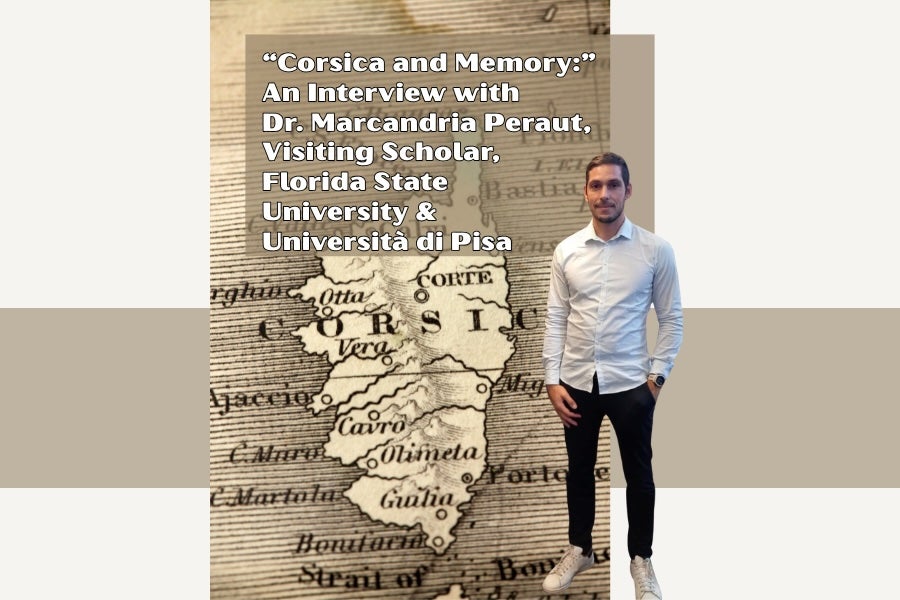
“Corsica and Memory:” An Interview with Dr. Marcandria Peraut, Visiting Scholar, Florida State University & Università di Pisa
Growing up in Corsica, my grandparents often took me camping. We did wild camping, but we also went to campsites. There I met tourists from all over Europe who spoke many different languages. I tried to talk to them in their language and got interested in other cultures. That eventually made me become interested in their histories too.
When I started university, I decided to pursue both my passions: languages and history. I studied English, Spanish, and Italian languages and civilizations. I went on student exchanges to Spain and Italy. I loved being a student and learning, but all through undergrad I was torn between focusing more on history or on language study. Unfortunately, I could not do a combined language and history M.A. at my university. Since I did not want to choose, I went to university in Romania instead. There I joined an M.A. program that let me continue learning more about English, Italian, and Spanish languages and cultures.
When I came back to Corsica, I decided to complete a second master’s degree in History with a concentration on Heritage. Both the built environment and the remembered past. That’s when I got introduced to oral history and the field of memory studies. The more I studied that, the more I became passionate about how people remember the past. I spoke with my supervisor and told him that I wanted to do a Ph.D.
I took a gap year, worked and traveled around Latin America, and kept thinking about what kind of Ph.D. project I wanted to research. When I came back, I knew that I wanted to work on popular memory in Corsica between the 18th century and today. I was lucky to get a grant to fund my research, and I was also paid to teach some classes.
How did you come up with your project?
That was a long process. It was hard in the beginning. My future supervisor asked me: "What kind of project do you want to work on?" and I told him: "Memory and Corsica." From there we went back and forth many times on what kind of memory, what sources, what time period. He helped me refine my thoughts and my project.
The basic premise of my Ph.D. research was that there was a gap between the history I had learned as a child from my family and what I saw commemorated in statues and plaques in Corsica’s towns. My first impulse had been to say: "What I learned as a child was all wrong." But then as I studied more, I realized that both ways of narrating the past could be correct. And I decided to record the stories people were telling about the past and turn those memories into an oral history archive.
What was your research process?
It was difficult to get started. Invariably, when I asked a villager how they remembered the past, I was told: ‘I know nothing. I stopped school at 12. I did not study anything.” I had to overcome that and make them feel comfortable telling me the stories that they had learned in their family. A second difficulty was that the past might hold conflicts and feuds. Telling a family’s past might produce violence and vengeance in the present.
I started talking with people from my village in Corsica. There everybody knew whose grandson I was, whose son I was. People would tell me: “I knew your father. - I know nothing but there is this …” and then they would tell me the stories that they remembered. It would have been impossible to set up these interviews without a personal connection. But I also had to give something back in these conversations. I could offer validation that their remembered past was not wrong. I could reassure them that I had found facts in the archives that supported the history they were telling.
I also understood that their memories could be wrong. The important thing was not necessarily whether a story was right or wrong, but why someone remembered the past the way they did. The past is literally in the past, so how does the specific way we construct the memory of our past help us in the present? Why did people construct their remembered past the way they did?
My dissertation has three central chapters based on three sets of interviews I did. For the first chapter, I interviewed 100 people. These were short, five-minute interviews, where I asked only one question: "What do you think of Paoli at this moment?" Paoli and Napoleon are the two most important historical figures from Corsica. Paoli first fought for Corsican independence, but several decades later, in the 1790s, he became an advocate for the French Revolution. Napoleon, of course, is more well-known; he became the ruler of France in 1799 and conquered much of Europe during the following years.
For the other two chapters I did long-form interviews, often lasting several hours. I spoke with 13 people from my own village, all of them at least 80 years old, and 19 from another village. With many I spoke four or five times. I wanted to record the histories that were remembered in their families.
What surprised you during your research?
The result of my research surprised me! I grew up thinking that Corsica was a rural place, a country where farmers worked the land, often with the help of their animals. An area where harvests were often poor. Then I moved to the city and thought: "Maybe it is just my family that lives like that." But then thanks to my research I discovered that most people living in Corsica were farmers like my family. Because of that, we have a desire to focus on telling the history of the great men of the island, Napoleon and Paoli, to describe Corsica as the birthplace of Napoleon and Paoli, and to neglect the rural history of the ordinary people.
How does your second project connect to the first?
One event in the remembered yet "unofficially forbidden" past of Corsica is the deportation of Corsicans in 1808. Hundreds of Corsicans were deported to other parts of France because they were supporters of Paoli and not Napoleon. I went to a village to collect oral histories about this event. It is not something that people will talk openly about, it is a painful memory, because having a family member that was deported meant that they were against France at the time, and many elderly Corsicans have been told that they should not be against France. So, it is a history that is transmitted within the family behind closed doors.
I went to the archives to see what records had been kept about this event but found almost nothing. However, there was a very big folder labelled "Deportations of West Indians to Corsica, 1802-1803." This was during my Ph.D. research, so I took some photos, made some notes, and told myself that I would come back for this material. I had not heard about this earlier deportation. I checked my records and the oral histories, if anything had been mentioned. Nothing. Then I reached out to people studying Caribbean history to see what they knew about this deportation. Nobody knew anything about it. I began to put together this second project while I was writing my Ph.D. dissertation. I got a postdoc fellowship and worked with a British scholar of the Caribbean, spending six months in Martinique and six months in Oxford doing research.
What did you discover?
Similar to the later deportation of 1808, the earlier one was undertaken by the government of Napoleon to deal with potential troublemakers. While the act of deporting people or populations considered to be a nuisance has a long history, one of the elements that sets the 1802-03 and 1808 deportations apart is that in both cases, people were arrested based on ruse and deception and deported without any legal trial. Napoleon had been trying to reconquer Saint-Domingue (Haiti) in 1802, but despite capturing Toussaint Louverture, the leader of the Haitian revolution, the reconquest failed due to armed resistance and disease. However, in their struggle to retake Haiti, French officials arrested many they thought were involved in the resistance fight. These arrests even included people who had actually fought on the French side.
What brings you to FSU?
I came to Florida State for a couple of reasons. On the one hand, I had learned that some of those deportees were sent to different places in North America, including what was then Spanish Florida. I wanted to discuss this history with scholars working in the field. On the other hand, I was aware that FSU had a large Napoleon collection and housed the Institute on Napoleon and the French Revolution. I reached out to its director, Rafe Blaufarb, and he invited me to come and stay in Tallahassee for a while.
You mentioned that you are passionate about oral history. How are you including that in your current project?
My specialty is memory. I want to find as many living relatives of the West Indian deportees to Corsica as possible to discover what of this event in their past has been remembered in their family. Last year, I made a list of all the people involved. For some we just have a first name, but we have the new name that they were given in Corsica. I started checking the names against the census records in Corsica and in Italy. I also use online sites like MyHeritage.com or Geneanet.org. Some stayed in Corsica, got married, had children, and set up businesses. Others moved away. Finding descendants will be a long process. So far, I have only found one family with living relatives. They moved from Corsica to Italy to Germany to Denmark and back to Germany. I have done some interviews with them.
I am also pursuing the 1808 Corsican deportees to France. Officially, they were not allowed to come back to Corsica. But the oral histories I collected mention that one of the deportees came back once. That is another strand that I am following.
What is coming next?
My goal is to publish a monograph on these deportees telling their stories. I will also want to write some peer-reviewed articles that focus more specifically on governing through the displacement of bodies.
The next project I have in mind is a connected history of Mediterranean and Caribbean islands. Although they are thousands of miles away, they share the same government. For example, when the French Revolution lost Corsica to the Anglo-Corsican Kingdom, they gained Martinique in the Caribbean. They lost one island and gained another. The islands also share other features. There are similar forms of ethnic revival happening in the 1960s, and there are also strong women figures who are remembered as heroines, Solitude in Guadeloupe and Maria Gentile in Corsica. I would like to look at this connected history from the 18th century to the 1960s.