
Internship at Heritage Village, Florida: An Interview with Chase Panish, M.A. student
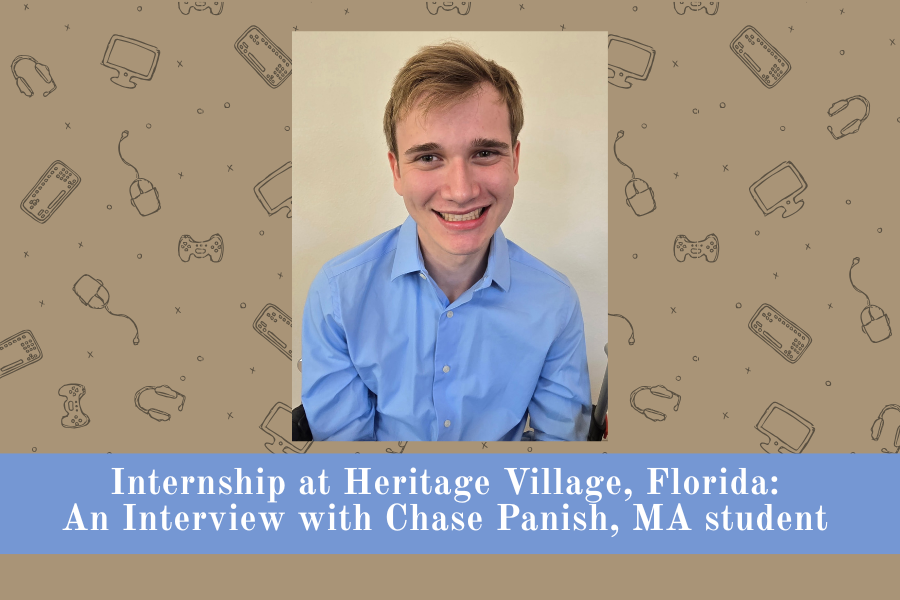
When I was younger, I spent a lot of time watching historical documentaries with my grandpa. Most of my family are in the medical field, so I did not have any background in history. In high school, I joined the History Quiz Bowl team – and I enjoyed that. That’s when my history teacher pulled me aside and said: you are very good at this, you could take this far, if you wanted to. I credit my teacher for making me think of history as a career.
I did my undergrad at Florida Gulf Coast University but wanted to do my master’s at a bigger institution. I looked around and really liked Dr. Kathleen Conti’s work, and I thought she would make a great mentor. We zoomed, I applied to FSU, and now I am in the M.A. program.
I started my journey into history through learning about U.S. presidents. My favorite president, the one I spent most time with is FDR. I am disabled. It is very rare to have leaders of countries be disabled. I became interested in his life, and then I have expanded my interest to other presidents. I read several books on different presidents every year just for fun.
Last summer, I did an internship at Heritage Village in Pinellas County. It is a public museum, a collection of historic houses and features around 30 of them. These historic structures were gathered from all over Pinellas County to illustrate its recent history. I am in two minds about manufactured historic sites like that, but I respect them because they are great places for learning. Plus, a larger collection of homes will attract more people than if they were on display individually in different locations.
Back in high school, I became AutoCAD certified. AutoCAD is an architecture program which is used to create precise drawings, models, and blueprints digitally, essentially acting as a high-tech digital drafting table for everything from buildings to mechanical parts. Heritage Village had gaps in their catalog of historic buildings and was looking to add more architectural drawings of their structures. I said: I am AutoCAD certified, I can do that for you. And I did.
Then I realized that one of their volunteers had been an architect before retirement, and that he knew how to use Revit which is another software program made to design, model, and document buildings and infrastructure – but in 3D. It is a more powerful, advanced version of AutoCAD. I asked him to teach me how to use this program, and to my joy he did. It turned out to be easier than I thought, mainly because I had my prior training in AutoCAD.
Heritage Village was looking to create a 3D map of their site. Once I had learned Revit, I began to build 3D houses for them, and I got pretty far with that (it is a long-term project, though). All of the houses were different, which meant each 3D model had to be designed from scratch. First, you survey the building in person, then you take photos. And from the photos you create a 2D sketch, which serves as the base for a 3D model. You start by creating a basic house, four walls and a roof. And from that basic version, you add in details. You’ll add the specific wood used in the planks; you add the correct doorknobs. You’ll add the right porch, and you just keep building out. Each of the historic homes is unique, they don’t have standardized doors, they have special doors. Each aspect has to be custom-built, even minor details. Putting it all together is rewarding, but it also takes time and can be difficult. I am glad that I learned how to do that.
I was surprised how fast I was able to learn the new software program. I had only limited experience with Revit (I have seen others used it but never used it myself), but I thought I’d give it a shot. I realized that when you dedicate yourself to something, even just for a week or two, you can learn very fast. I also gained an appreciation for small architectural details which most people visiting these houses will overlook, but that the builder put in to create a more beautiful house.
While I am generally a patient person, this project required an extreme amount of patience. You have to get into a zone. I have read about flow state, and I experienced that when I worked on the 3D models. It was an interesting feeling and taught me the limits of my abilities and how to push beyond them.
I believe that museums and other historic sites will eventually become more technologically advanced. My experience with Revit and AutoCAD will help me in my future work. I think in the next few years, museums will embrace virtual reality. As this technology becomes more affordable, it will be easier to adopt it widely. And when that happens, you’ll need people who can build the 3D models. It will make museums and historic sites more accessible, especially historic sites which might have quirky layouts or stairs which makes them inaccessible for those in wheelchairs. So, even if you can’t get inside, you can put on this headset and experience the exhibit, nonetheless.
Another thing I gained appreciation for is the work people do in small museums. Heritage Village had only a handful of permanent staff – they were supported in their work by volunteers – which meant that each staff member had to wear multiple hats. I learned so much from each person because everybody came together and pitched in. It made me think about what size museum I would like to work for (if I get a choice). Because depending on the size you will become more or less specialized in your work. For me, I think the best place would be a medium-sized institution. For the ideas about accessibility that I have, I need some institutional support and backing which might be easier to find in a medium-sized place.