
Excavating in the Decapolis: An Interview with Daniel Eide (FSU B.S. History 2025)
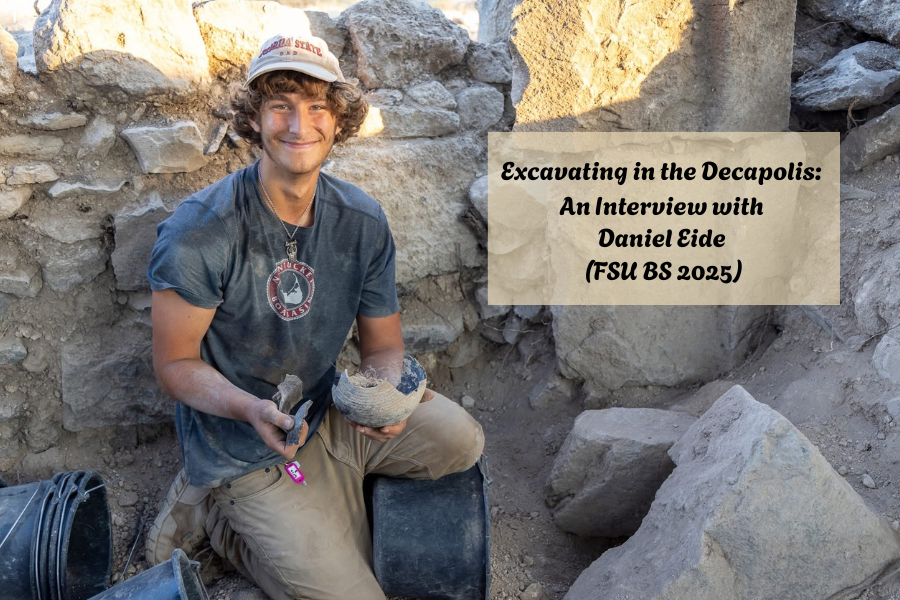
During my last summer of undergrad, I spent four weeks on a Greco-Roman dig site. I found the dig through the Archaeological Institute of America’s website which listed all the recognized archeological excavations around the world in which U.S. students can participate. I am very interested in Greek culture and had always wanted to visit Israel. When I saw that there was a dig on a Greco-Roman site, Hippos-Sussita, in northern Israel, I applied to that program, the Hippos (Sussita) Excavations Project, and got accepted.
The ancient city of Hippos is located on the eastern shore of the Sea of Galilee, on top of Mount Sussita, and is now open as a national park. It was founded after 200 BCE by the Seleucids. It was one of the centers of Greek culture in the region and continued to be so during the Roman and early Umayyad periods. After coming under Roman Imperial administration in 63 BCE Hippos became one of the Decapolis, a loose confederation of ten Hellenized cities set up by the Roman General Pompey Magnus. Hippos flourished during the Roman period; by the fourth century CE, its inhabitants were mainly Christian. The city was destroyed by a major earthquake in 749 CE and never resettled. Archeological digs have taken place at the site for several decades.
All the summer students and staff lived in the Kibbutz, Ein Gev. It is a small kibbutz close to the dig site. We were about 30 people altogether, from all around the globe including Germany, the U.K., Italy and Israel. It was very easy to make friends as everybody spoke English.
Part of the application requirement was to have done some coursework in archeology or anthropology or another related discipline. I am a History major, but I have also taken anthropology classes – and the director of the program accepted that. Instructions on how and what to dig were hands-on in the field. We were shown what kind of pottery shards to collect - pottery pieces with a rim. These are known as "indicative" pieces as they can be dated more easily. Important finds go to the Israeli Antiquities Authorities, pottery shards go to the University of Haifa, one of the centers for archeological studies in Israel. Part of my job when finding objects was to measure and record the sea-level elevation of their location.
This year’s dig focused mostly on two areas: one was a cathedral, the other a home for the elderly. I was assigned to work on the home for the elderly. About two dozen buildings have been excavated in Hippos so far. The place looks like a smaller version of Pompei, Italy. Because of the earthquake, a lot of the bigger building blocks rolled down the hill and fell into the houses lower down. This makes the excavated structures look less monumental. Other Decapolis are more grandiose, and many have also been completely excavated. Hippos has a lot more scope for archeological activities. About two thirds of its buildings are still underground.
Our work schedule was organized to avoid being out during the hottest part of the day. At 4:30 a.m. we were on the bus to the dig site and started digging at 5 a.m. Excavation work went on for about seven hours, but there was a coffee break, and a breakfast break, and finally a fruit break in between. The last hour of the morning dig was the hardest to get through – as it got hotter and the work seemed heavier! Besides excavating at the home for the elderly, I also participated in the rock removal activities. That was physically very tough. We worked until noon and then returned to the kibbutz for lunch. Sometimes we had educational events in the afternoons, but most of the time we were left to ourselves.
We also undertook some weekend trips. We stayed in the area for most of them, but the last weekend, we went to Haifa, which was a bustling city. Locally, we visited some ancient synagogues in the Golan and Galilee, including the Sepphoris Synagogue, where the Mishnah, Judaism’s oral tradition, was compiled in written form for the first time by Judah ha-Nasi. We visited Beit She’an, one of the other Decapolis, and where King Saul was defeated by the Philistines according to the traditional narrative found in the Hebrew Bible. We also visited the cave that had formerly contained the source of the Jordan river. A cave-in during the medieval period shifted the spring several hundred feet east.
The most enjoyable part of the dig for me was hanging out with all the other students in the kibbutz. After dinner, we would sit, talk, and exchange views, I met students from not only the University of Haifa, but also Columbia University, as well as young professionals in the field. It was an incredible experience, and I hope to return to the dig again this coming summer.