
What’s it like to be a teacher? An interview with Baylee Staufenbiel, Ph.D. candidate in History
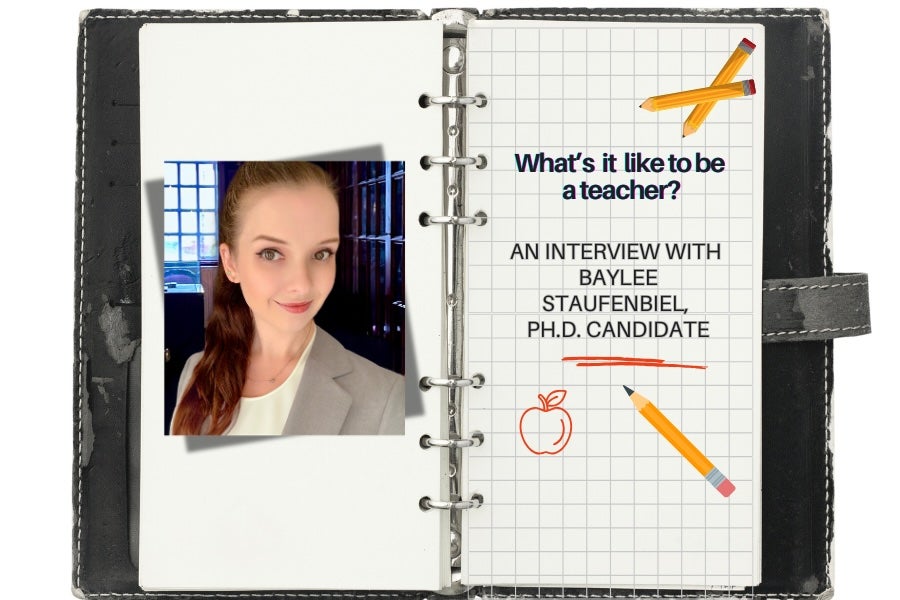
Baylee Staufenbiel came to FSU in 2020 to research medieval medical history. The specific focus of her research is the notion that women have a seven-chambered uterus as set out in the medieval medical canon. Staufenbiel had her first teaching experience as an M.A. student at the University of Wyoming in Laramie where she ran her own discussion sections for two different classes: a survey of western civilizations as well as the history of Wyoming. “We controlled Fridays. As long as we stayed close to what the professor had lectured about on Monday and Wednesday, we could make our own schedule for the Friday discussion section.” At FSU, Staufenbiel has taught both upper-division courses and lower-division surveys. Her teaching portfolio includes Medicine and Society and The Historian’s Craft. She is currently teaching World History from 1450 to 1815.
How does it feel to teach?
I enjoy teaching. It is certainly different being the instructor of record from running your own discussion section. You have to theme an entire class for a whole semester and come up with all the lectures. Yet teaching is an integral part of what historians do. We research and learn new things, we write about them, and then we transmit that knowledge to others.
I enjoy talking to my students, asking them: “What would you like to know?” - and then coming up with new ways to engage my students. I like to flip narratives on their heads, especially what might seem like the normal sequence of things. I also try new pedagogical approaches. For example, when we were talking about manuscripts, I explained that many people believe that people in the Middle Ages were not literate. And I said that this is not necessarily true as there are many ways in which people can read. They might not recognize every word, but they could string the overall meaning together. Another way in which people understood things was through images which were in many books. That helped them know which Bible story they were reading or what liturgy they were reciting. In class, I divided the students into groups and gave each one a page from a Book of Hours with the text in Latin. Then I asked them to describe what they were seeing, and what type of book they were looking at. The students all realized that they were looking at a religious text and were very interested in the details in the images to work out what the text might be about.
Another time, when we were talking about the impact of print on early modern Europe. Most of the students had heard that Gutenberg’s printing press ended the manuscript tradition, standardized texts, and thus changed the transmission of information. As an activity, I gave each group of students four different wood blocks depicting a ship, a crowd, a walled city, and a generic ruler as well as a piece of construction paper. Then I reminded them of a scenario we had discussed in class, the Mongols bringing the plague to Caffa on the Black Sea in 1346. I said ‘Using only these four wood blocks, your group has to depict that event on the page. You can’t write anything down in words, but you can draw with these markers.’ By the end of class, we had 12 different pages telling the same story. The students realized that even having the same starting information and the same woodblocks, this did not mean that they relayed the information in the same way. Similarly, the printing press did not streamline information, especially as there were multiple presses which all did their own thing. Plus, the symbols used in manuscripts continued to be integrated into moveable typefaces. Through this hands-on project, the students understood the complexities of the introduction of print to society.
What is your goal as a teacher?
My big goal is to get the students to do more than just listen to me giving them concepts or reading the concepts themselves. I want them to understand them through hands-on activities. I also want them to enjoy what we are doing. When I taught The Historian’s Craft, I asked the class, "Since this is about introducing you to being historians, what do you want to learn about?" And then I set time aside in the following weeks to address the topics they wanted to know more about. These are some of my little ways in which I am hoping to bridge the gap between student and instructor. I want students not to dread coming to class.
How do you know that a class was a success?
When I see the students engaging with what we are doing. Sometimes they just sit there and are unwilling to answer questions. Is that because they did not understand the question or did they just want to follow along quietly? And then, when I rephrase the question, present the scenario in a different way, it clicks and their hands go up. Suddenly they got it. While we were doing the different activities in class, I did not see any phones or laptops being used. I saw students laugh and talk about the tasks they were doing. They had fun making things that I asked them to do. That to me is a class that is successful. One day at a time.
What have you learned from your students?
One thing that I am realizing increasingly is how interested our students are in history. They might just not know how to ask questions, or they might not know how to approach the instructor. They might be self-conscious or shy or don’t want to appear stupid in front of the others. I try and include myself in the learning process. I will tell them, I did not know this, but I learned about it while making this lecture. I want to remind them that we are always learning. Over time that means that I get more questions from the students. Sometimes these are questions about details I do not know myself. Then I tell them, I will look this up and tell you next time. Or someone in class can look it up right now. The students are curious about things I mention, they just don’t always know if it’s OK to ask a specific question or if it is off topic. But when they see that I am learning and having fun preparing the lectures, they become more comfortable in the classroom. They get to have fun. And we all have a good day.
What has teaching taught you about yourself?
Teaching has taught me to be kinder to both me and others. Sometimes we set our expectations a little too high, and we forget that we are all just human beings. We can’t be super teacher or super student every day. I am also aware that if I am asking my students to comply with deadlines, I need to do the same. That’s only fair. Equal dedication.
How did leading discussion sections help you become a better teacher?
Leading discussion taught me a lot of improv skills. It also showed me that doing creative things engaged the students a lot more than if I just talked at them. I got used to standing in front of students and learned how to communicate the knowledge authoritatively so that they did well in their tests and papers. Today, I am not nervous when teaching, and I learned how to work the classroom.
Was there a particular teacher in undergrad who inspired you? How and why?
There were two that I remember well. One was the instructor of the first history class I took as an undergrad, Mira Green. She was a teaching assistant at the time. During my undergrad years, she got her Ph.D. and was hired as a lecturer. I valued her honesty and was inspired by seeing her progress through the grad program and become faculty. She became my recommender for grad school — which she had counseled me against pursuing. The other person was the professor Dr. Green TAed for, Robin Stacey. She was one of the first people to integrate the Reacting To The Past pedagogy in her classroom. This involved immersive historical role-playing games. When I took Dr. Stacey’s class, we role played Joan of Arc, and I was actually Pope Boniface VIII. I made a Pope hat, we all got dressed up for class, and we also spent time distressing paper documents to make them look medieval. It is this kind of learning that I enjoyed and that I want to bring to my students.
I start each class with a joke of the day, so that students begin the session with a laugh. It can be a cheesy or a lame joke: “Why did the merchant bring a ladder on the Silk Road? Because trade had its ups and downs.” The main thing is it makes the students smile. It’s a great ice breaker. It changes the vibe.